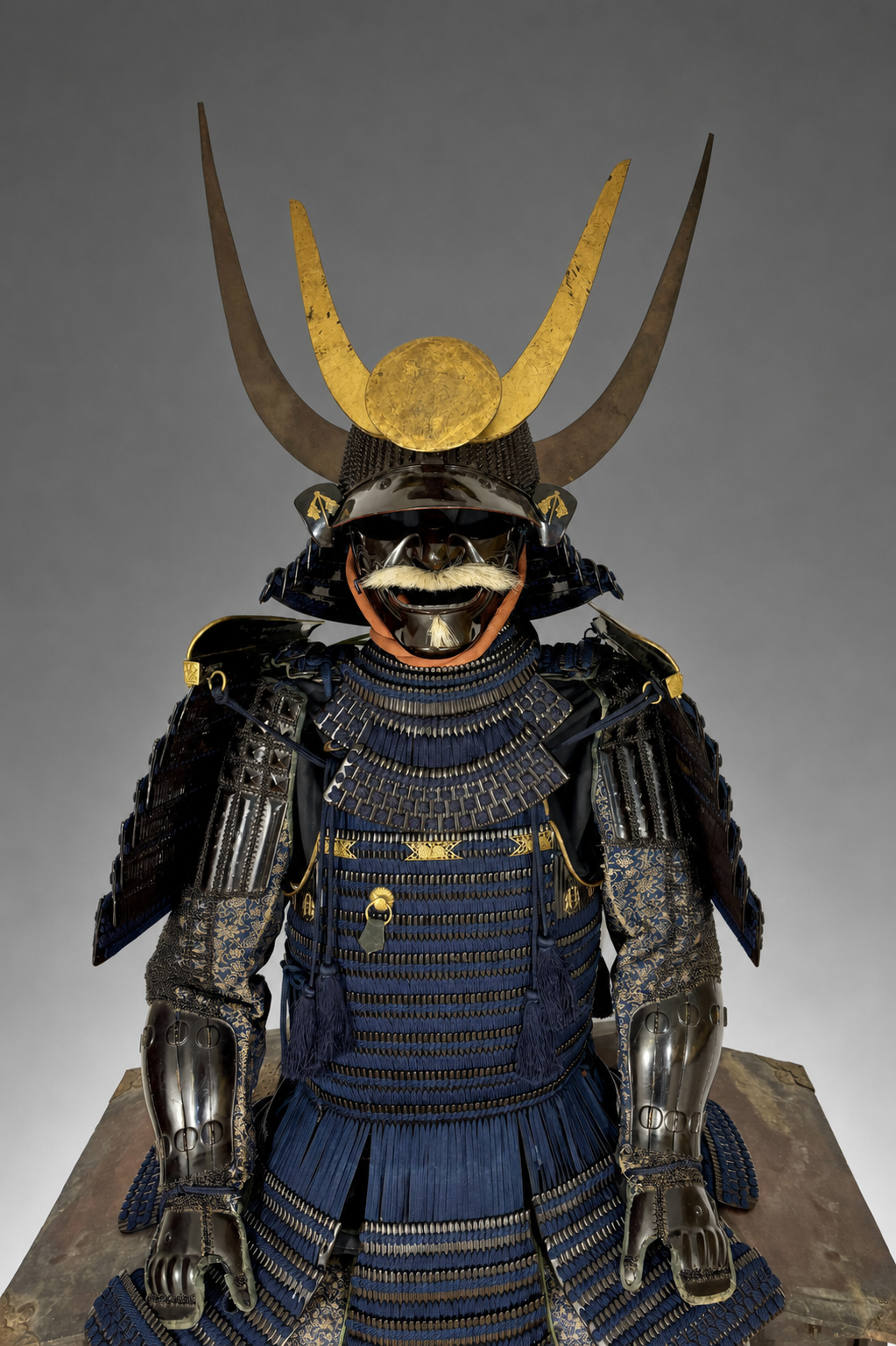
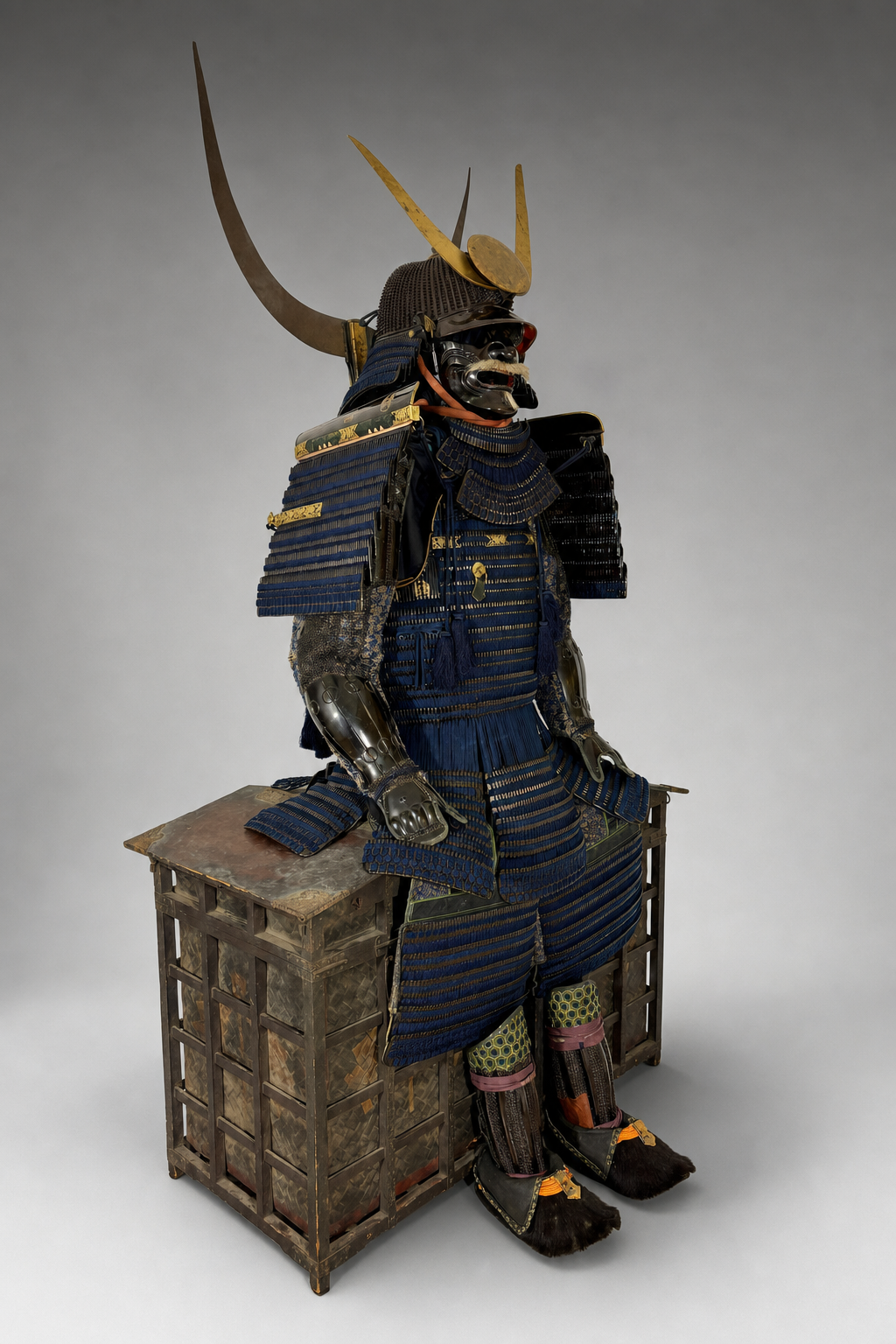
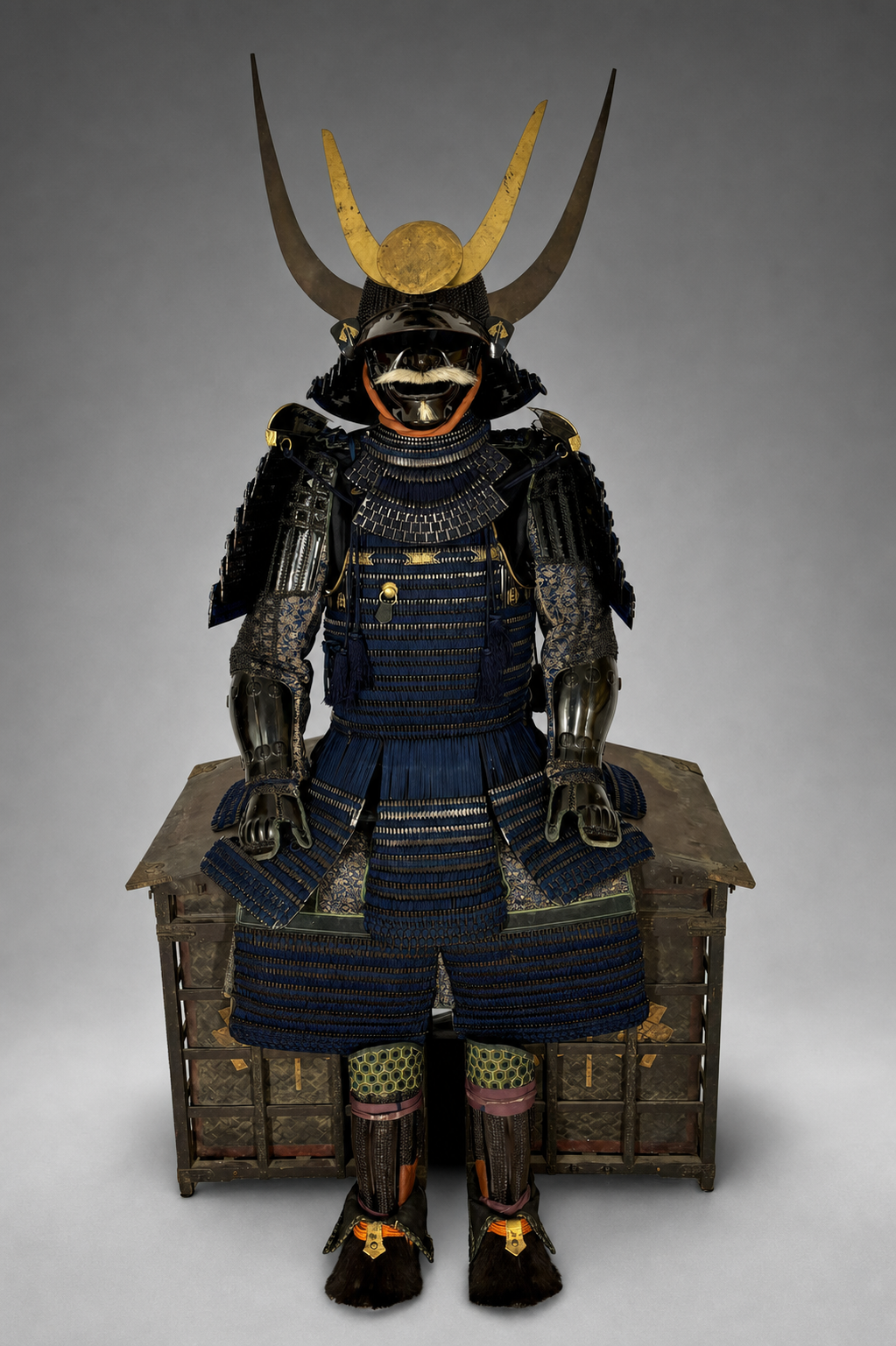
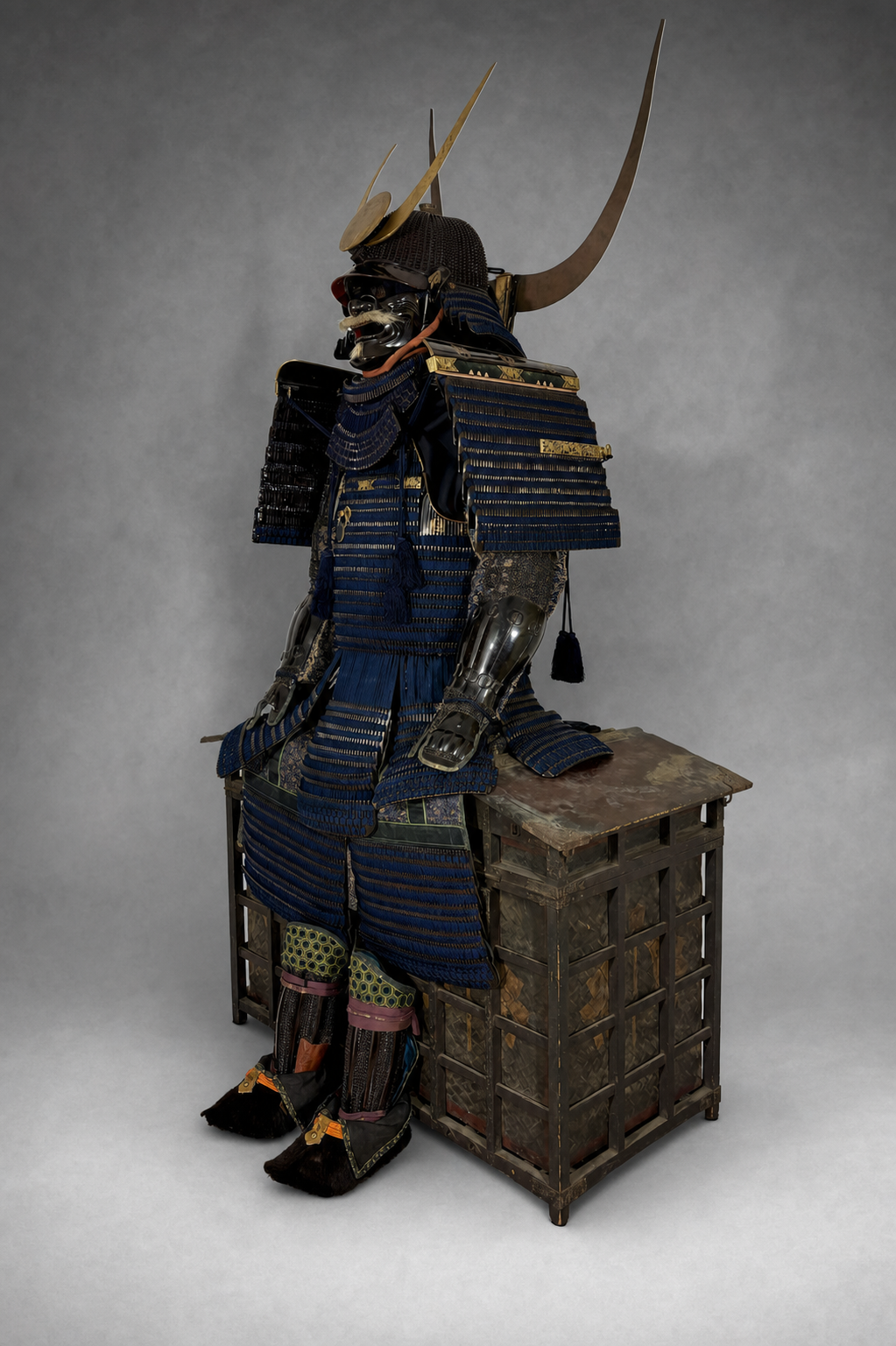
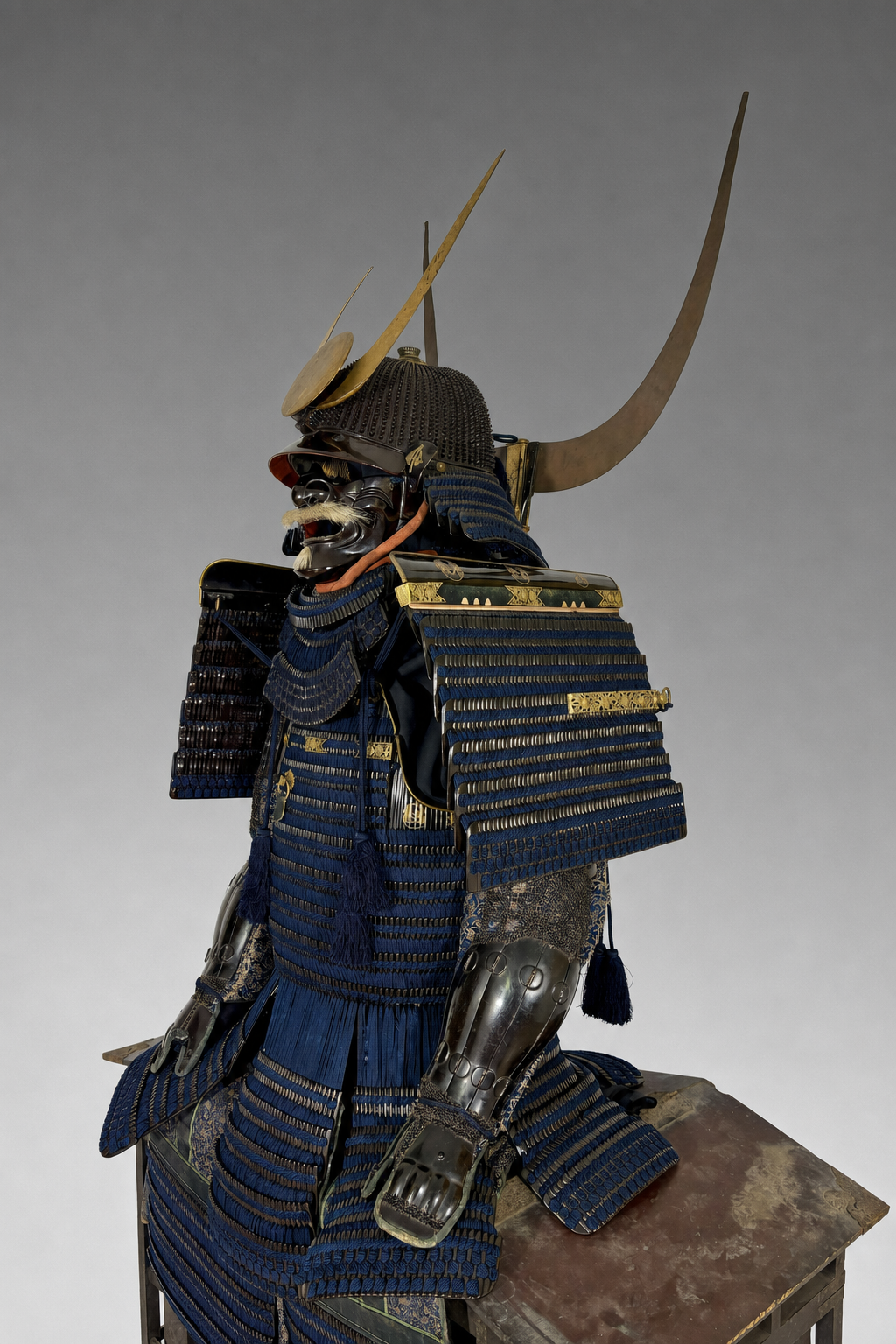
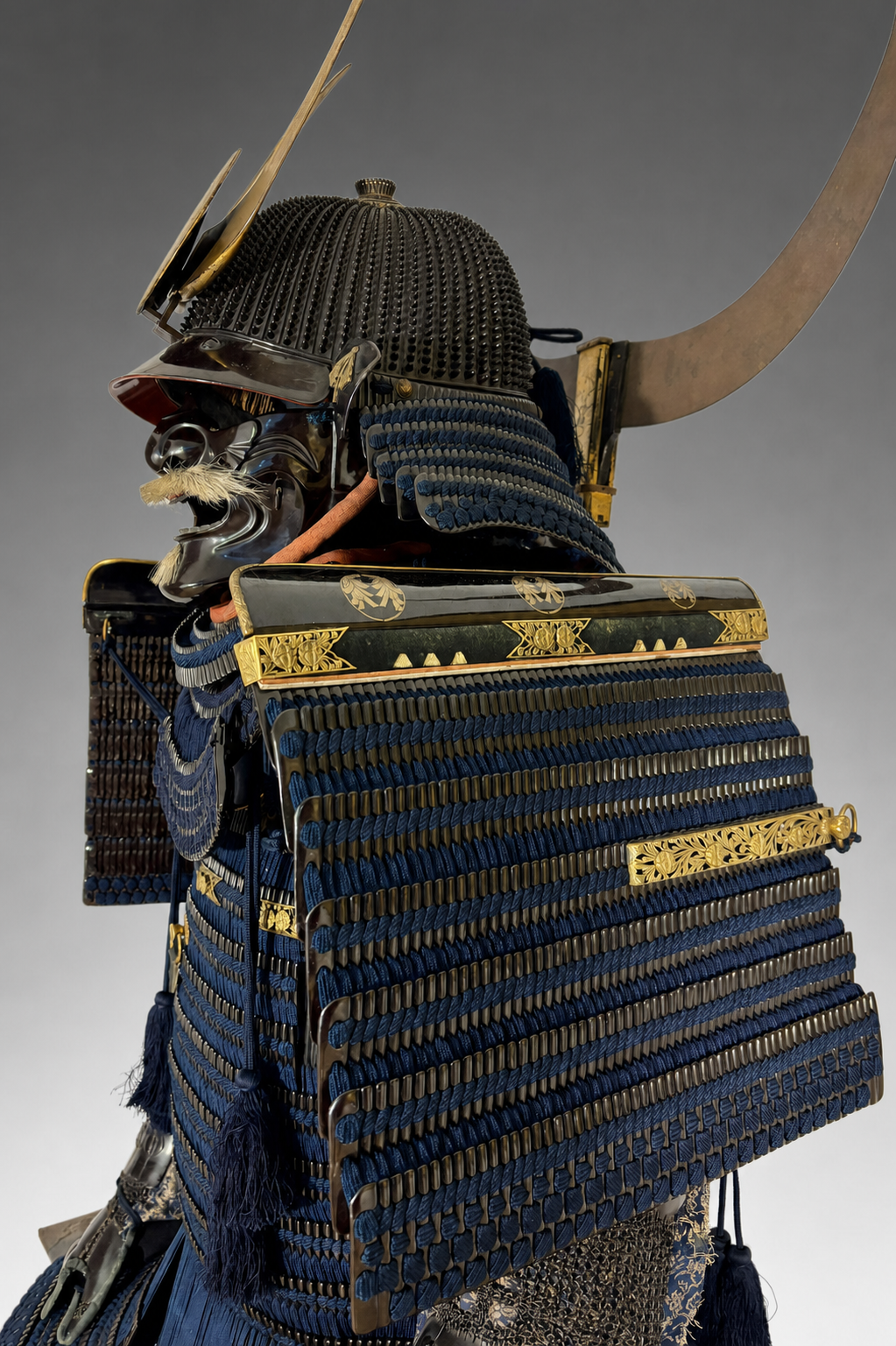
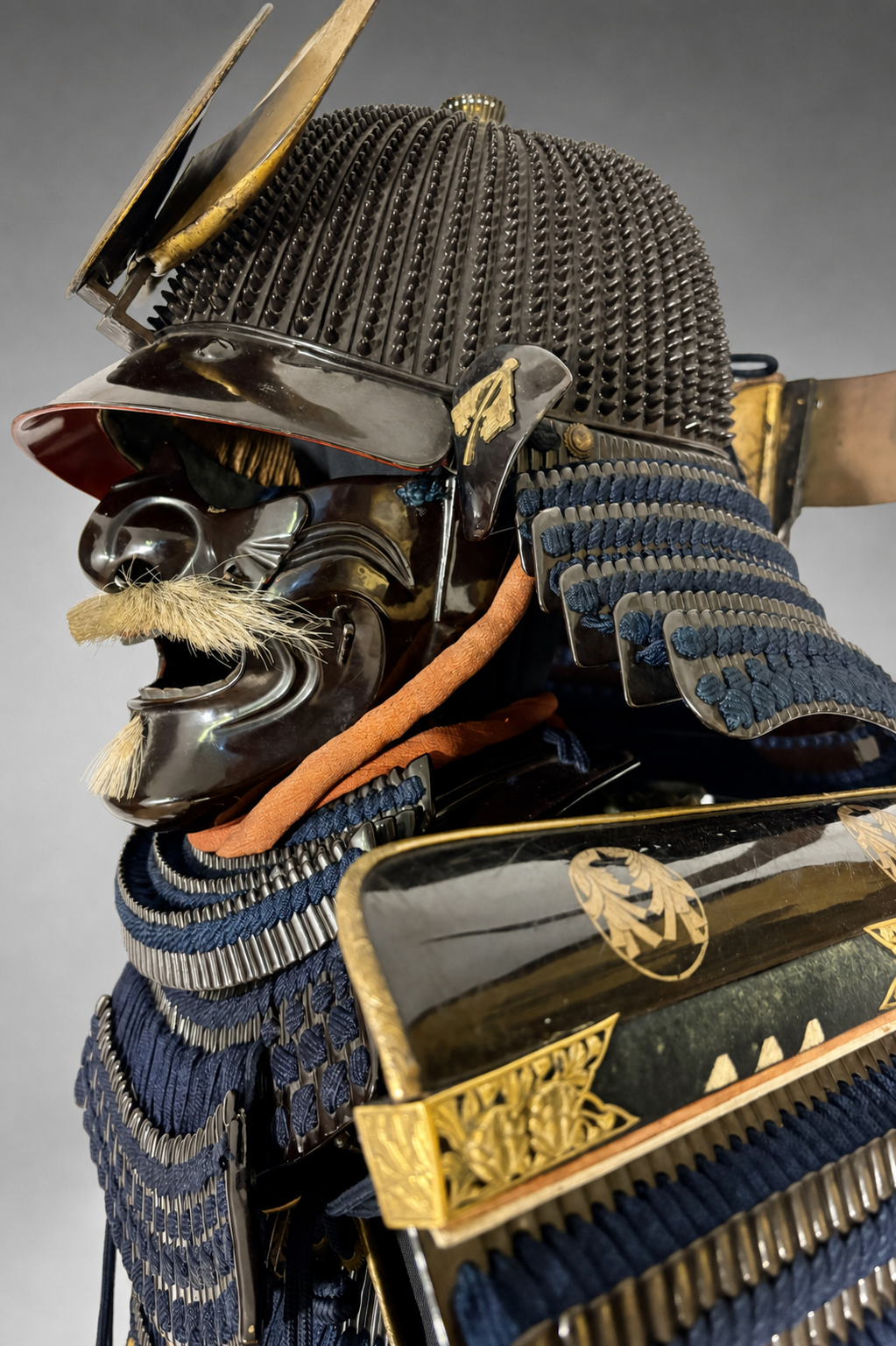
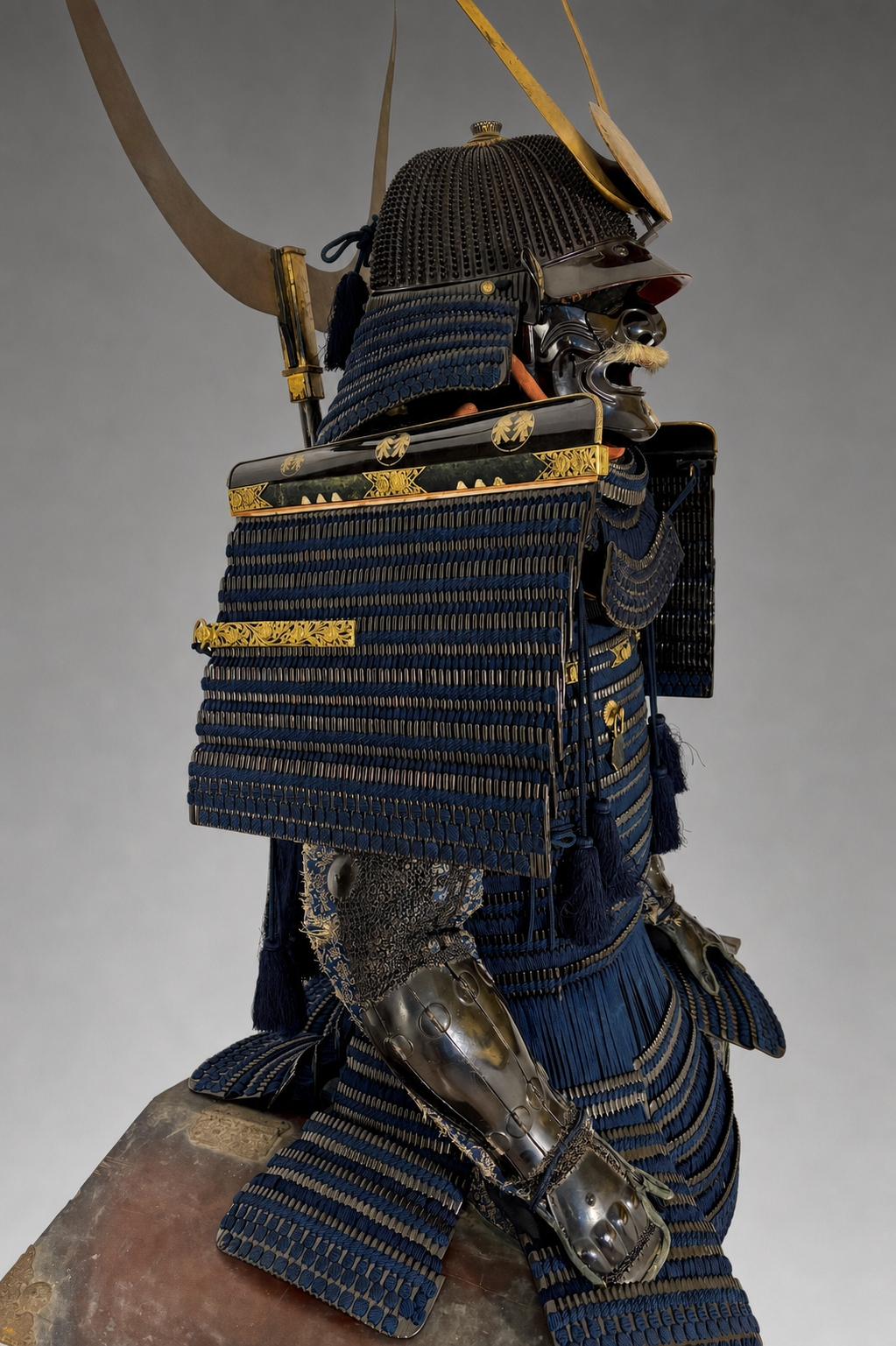
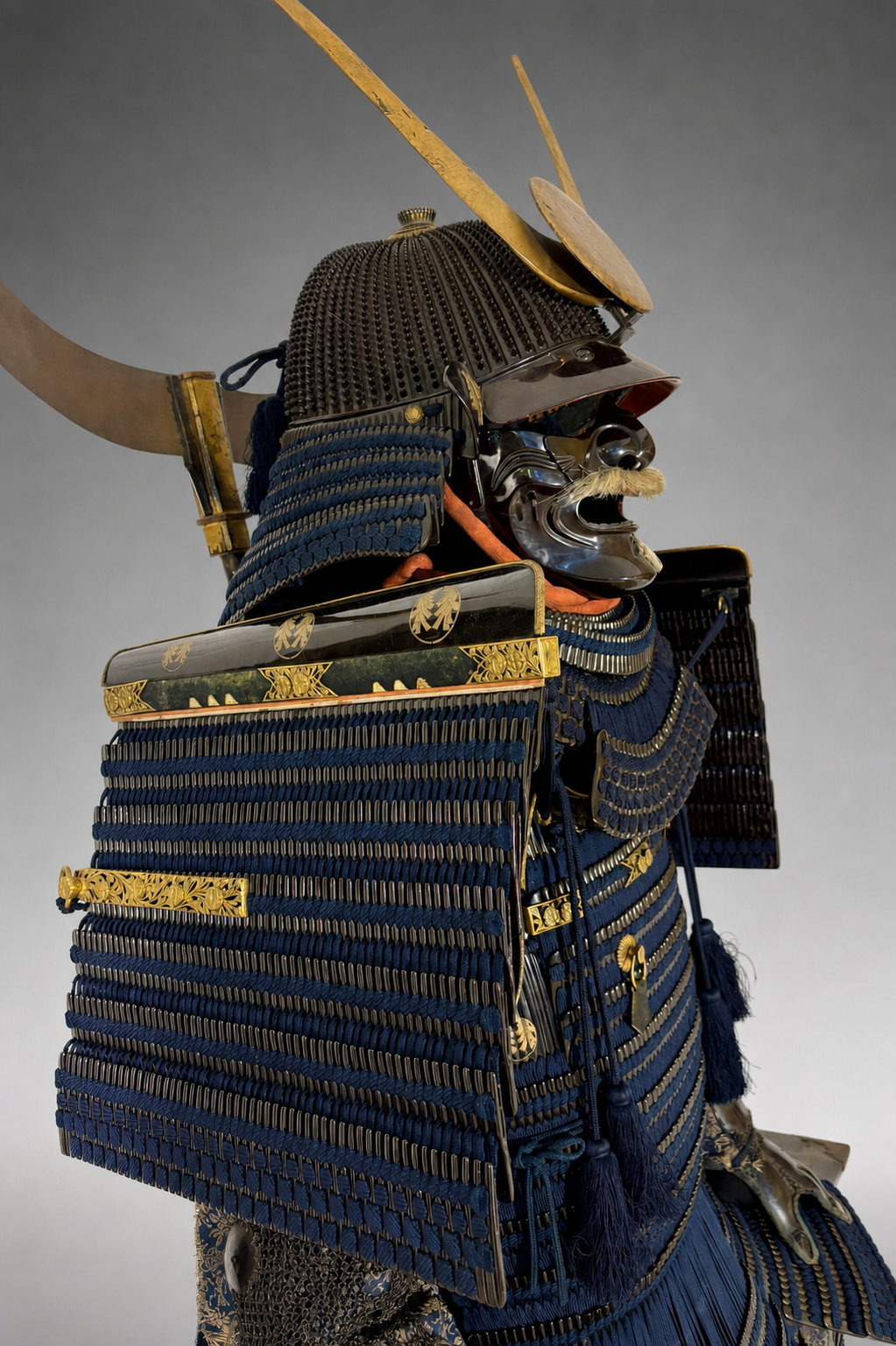
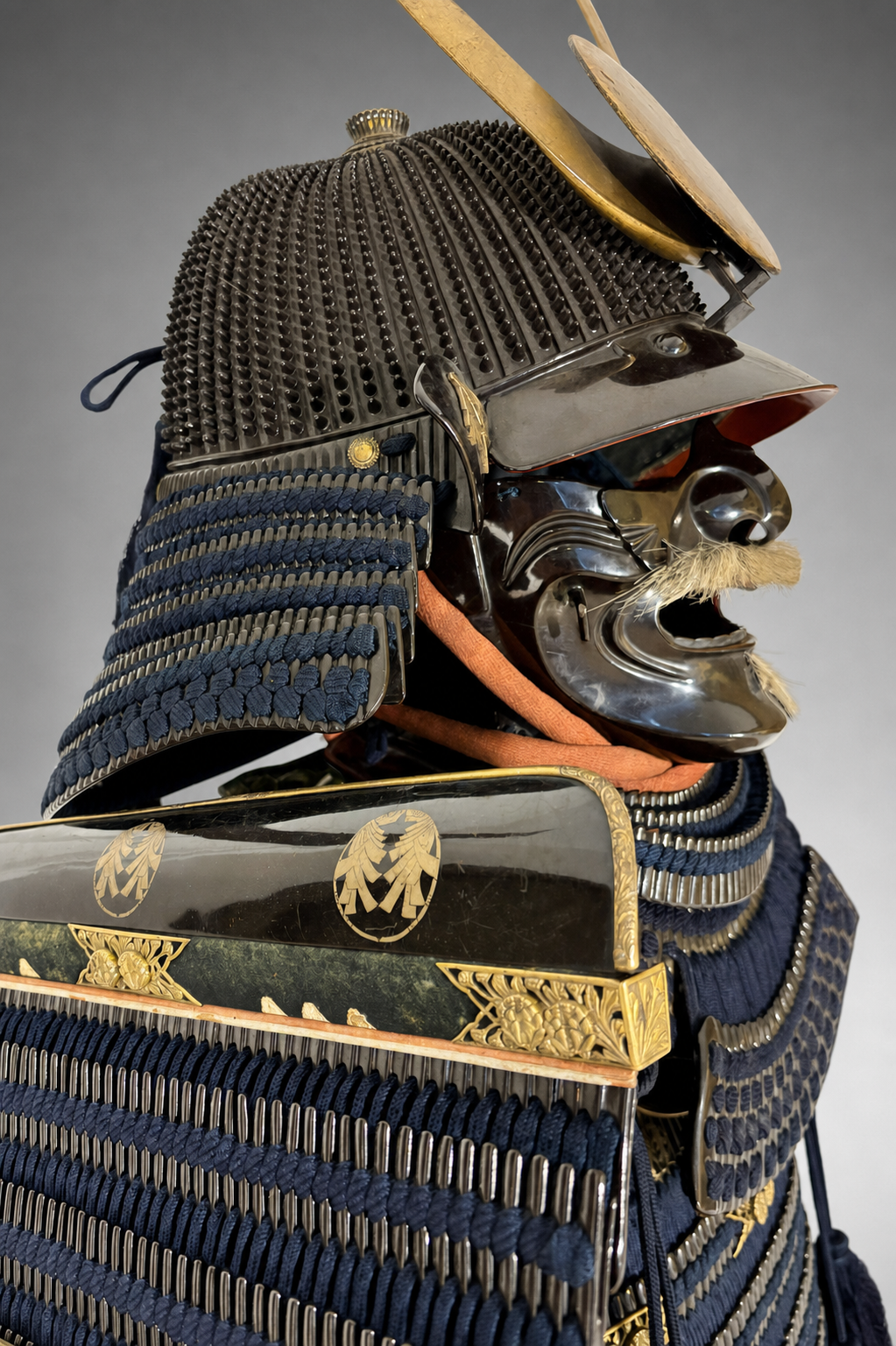
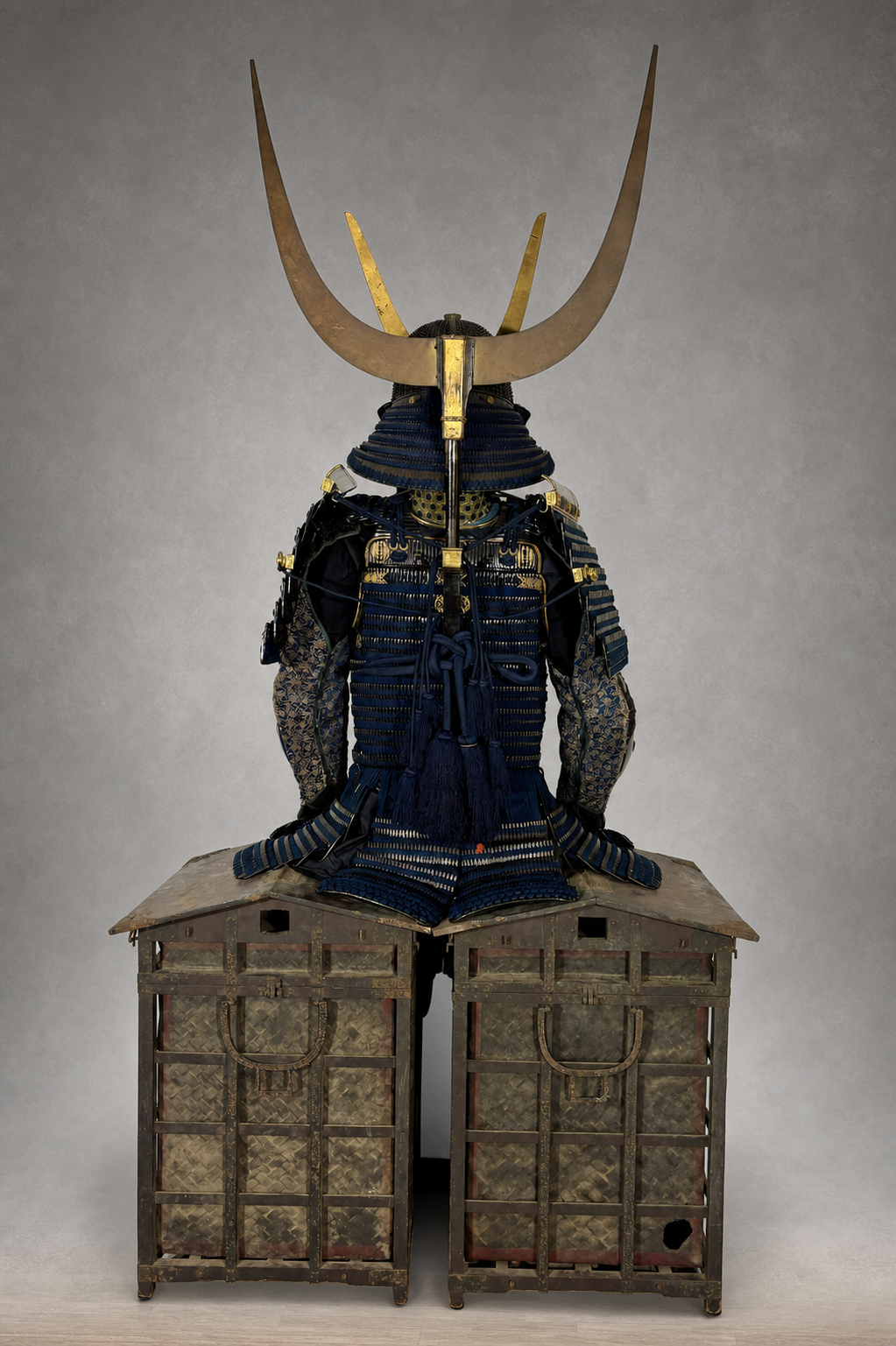
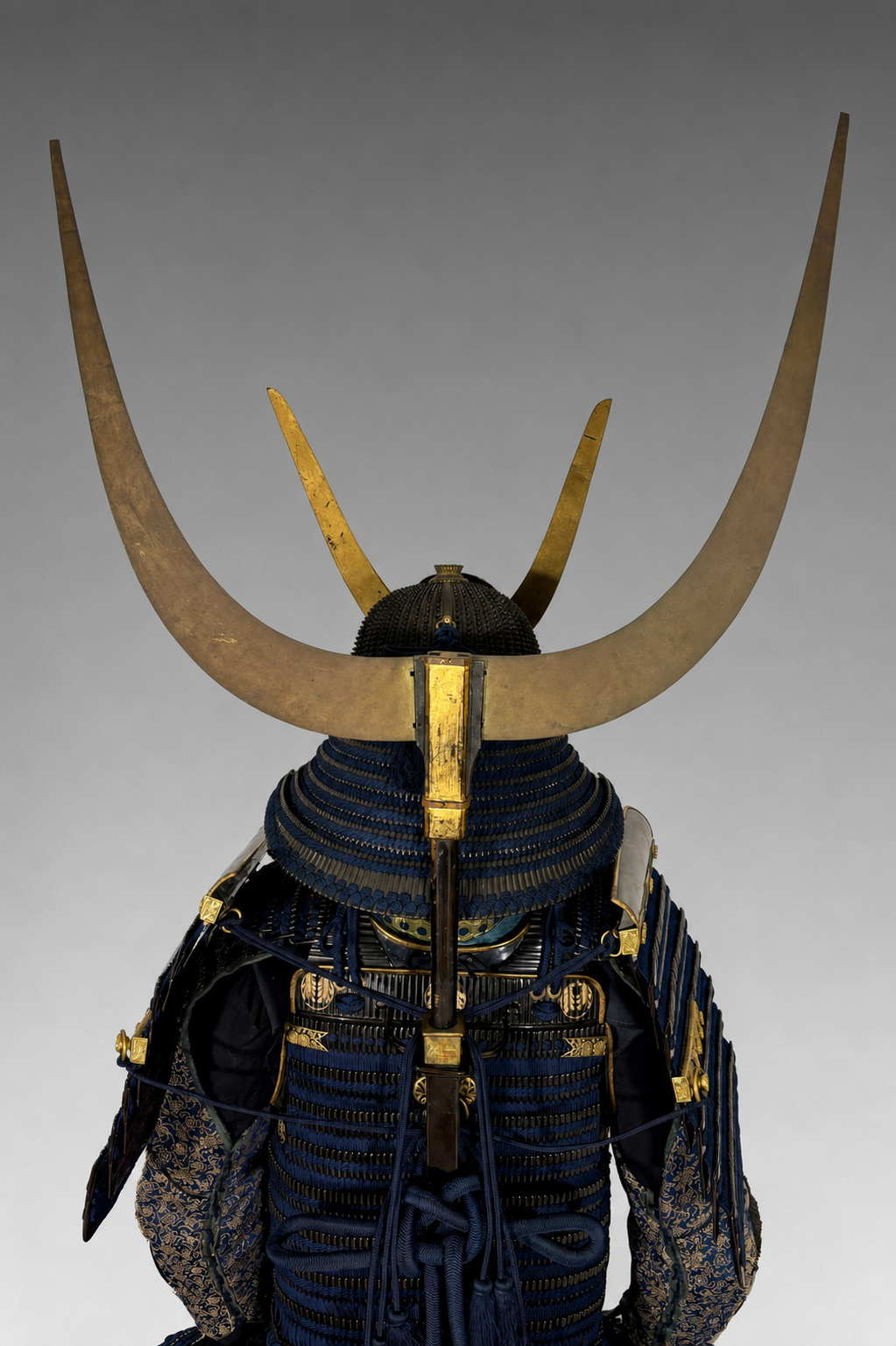
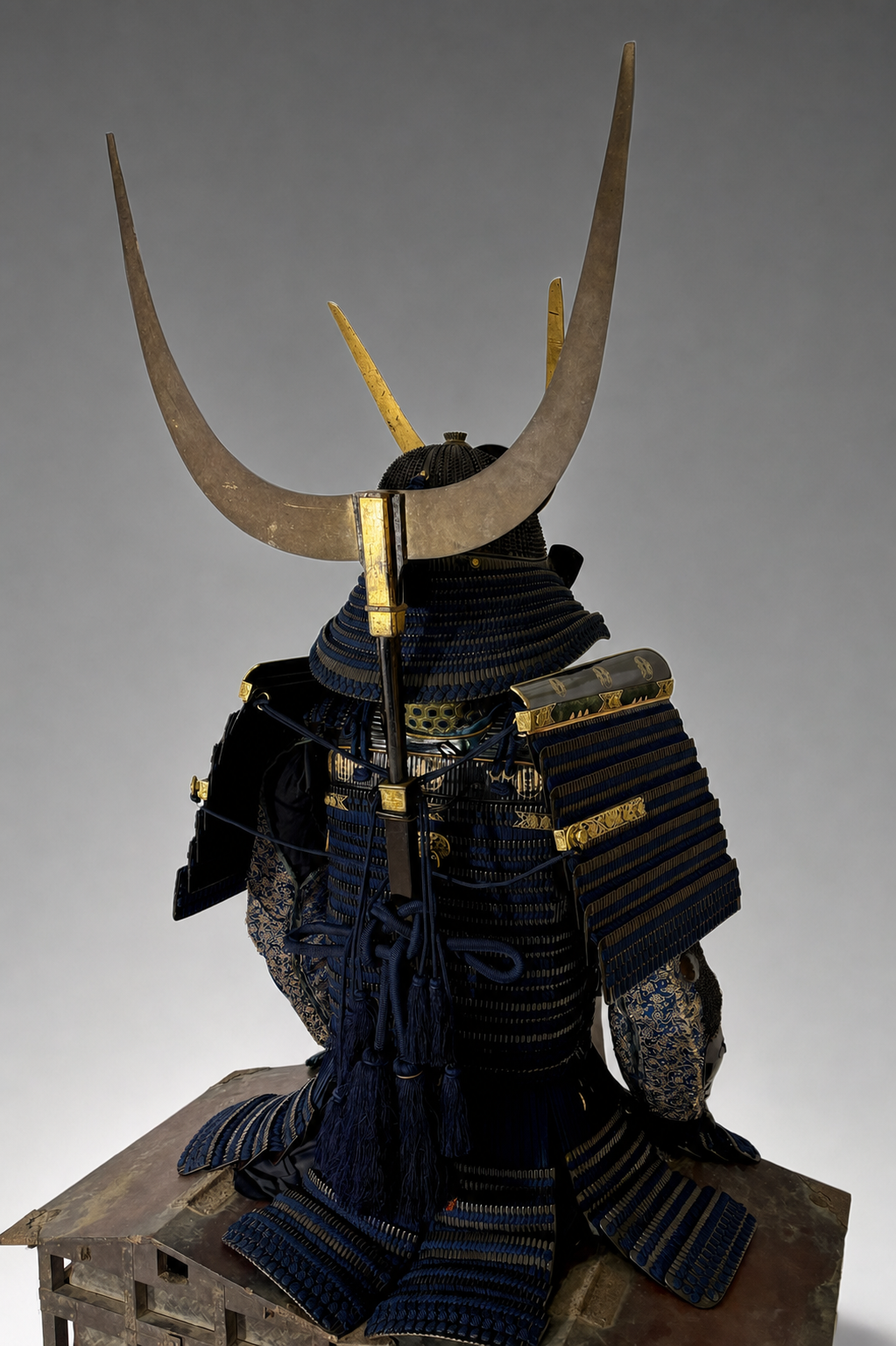
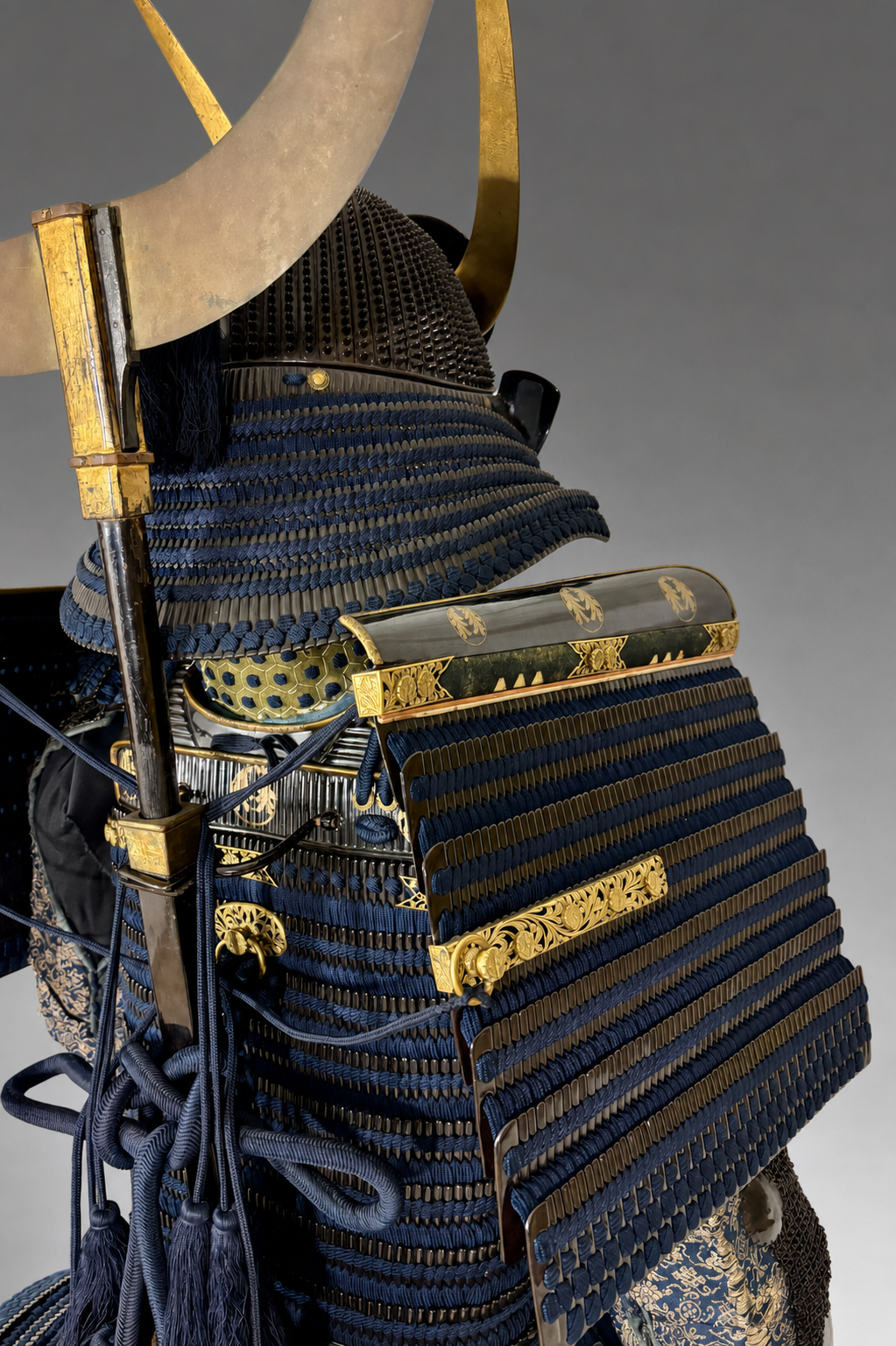
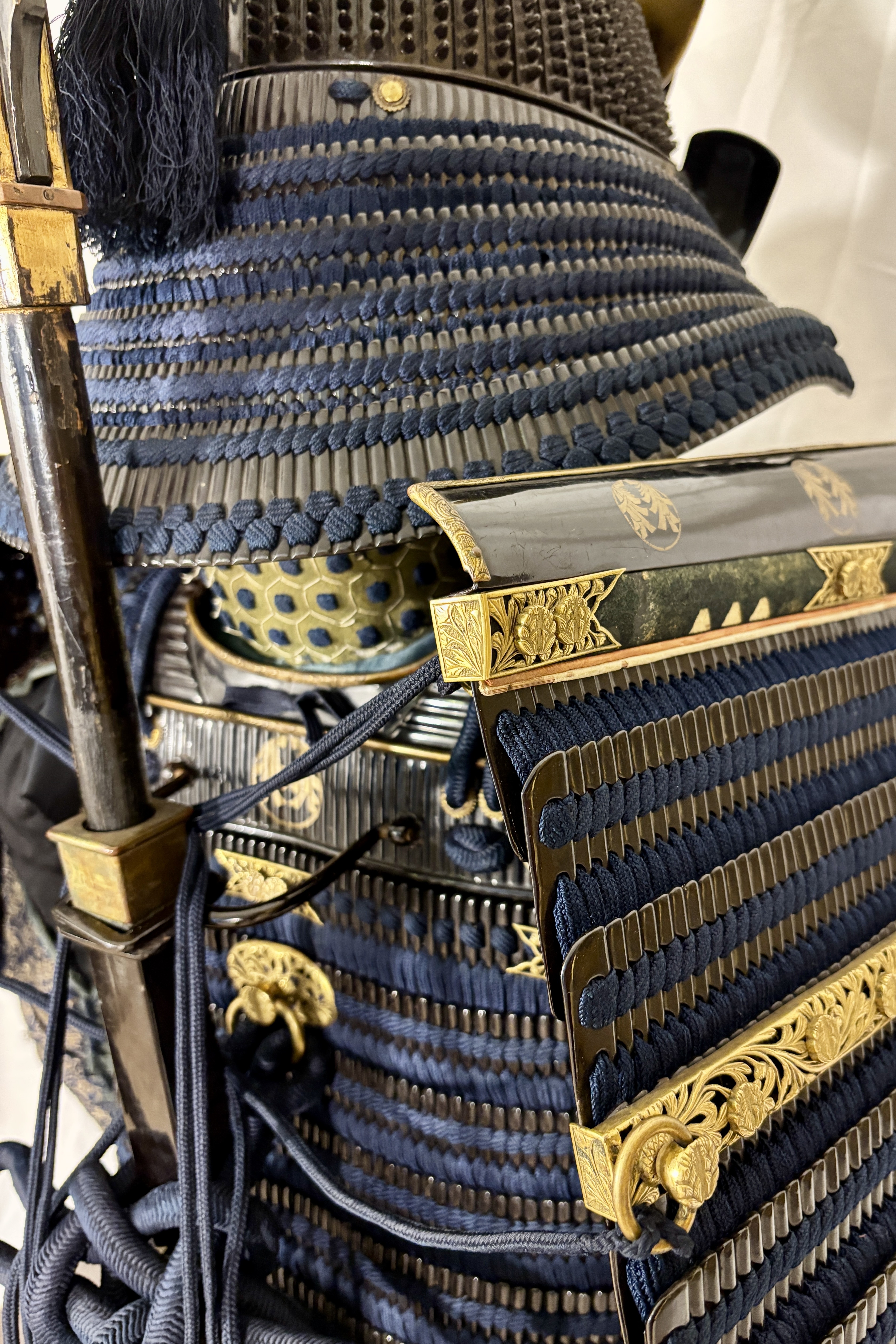
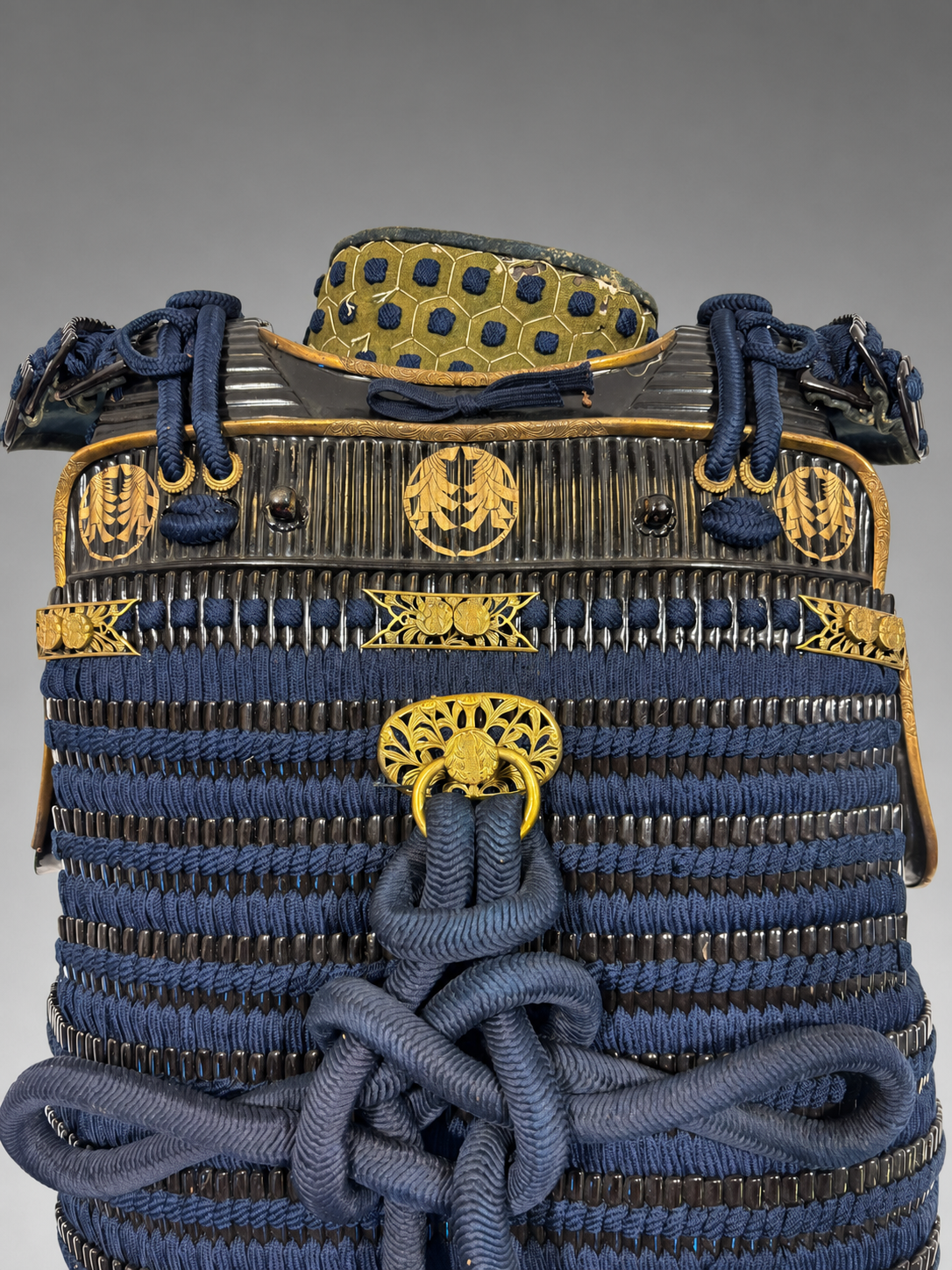
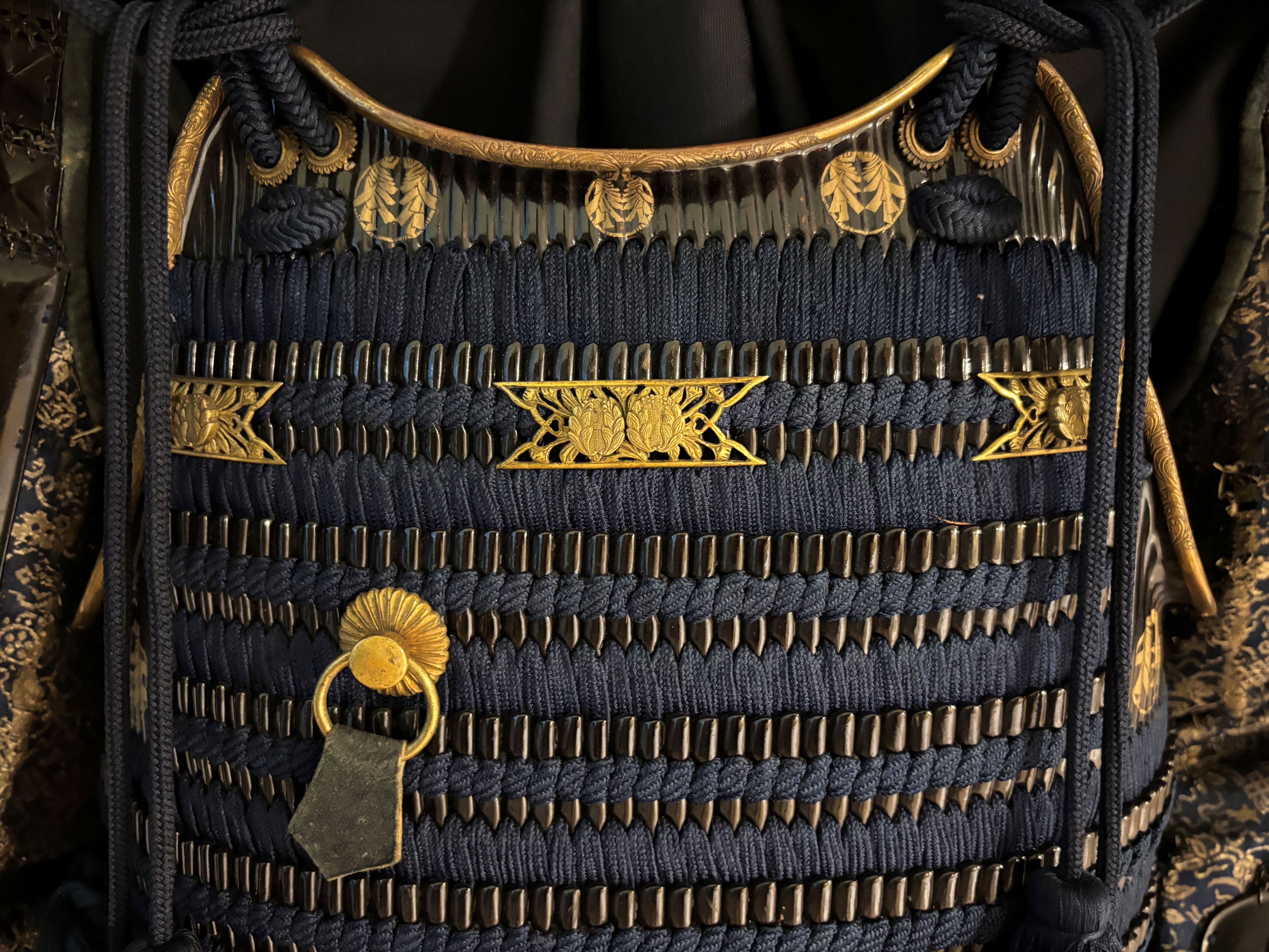
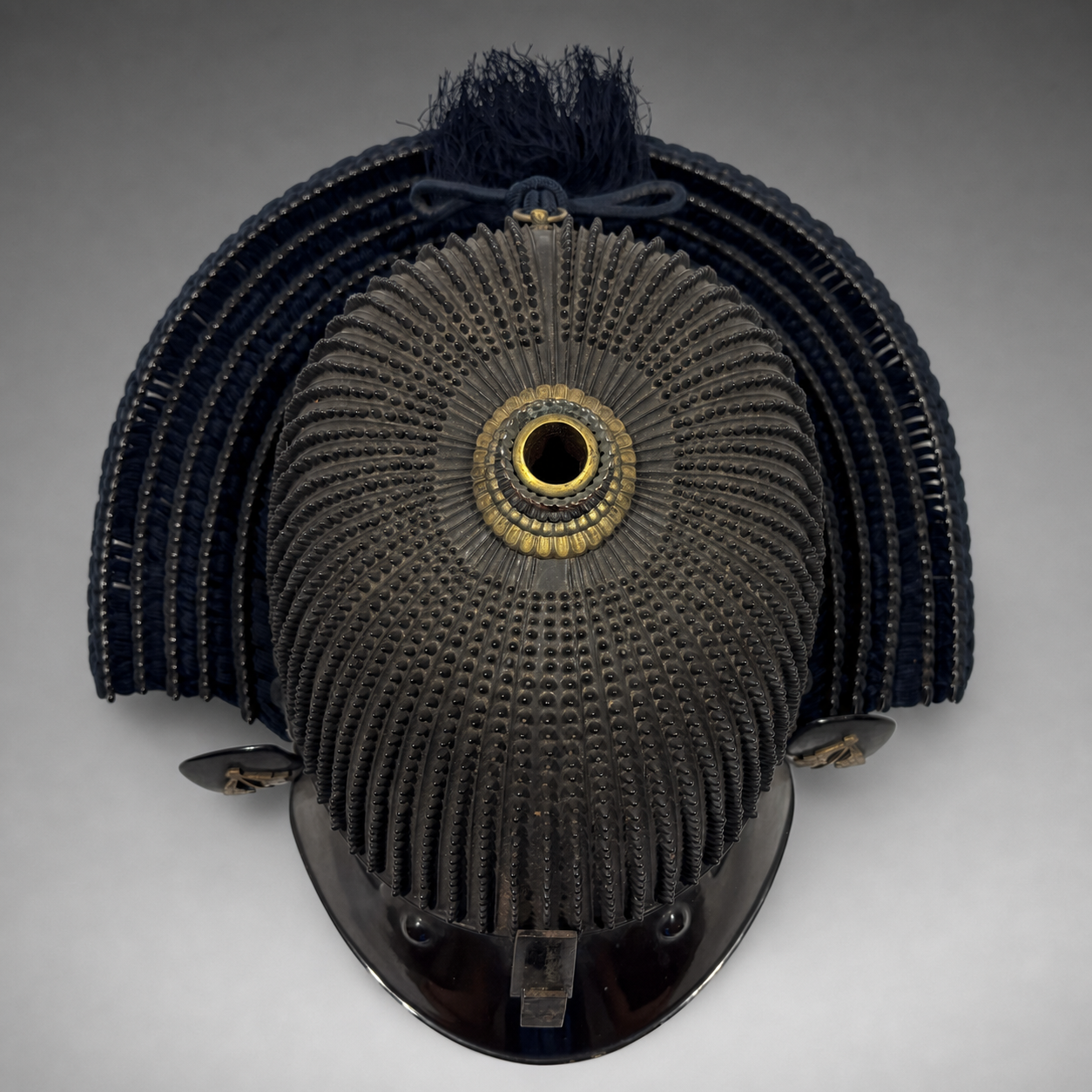
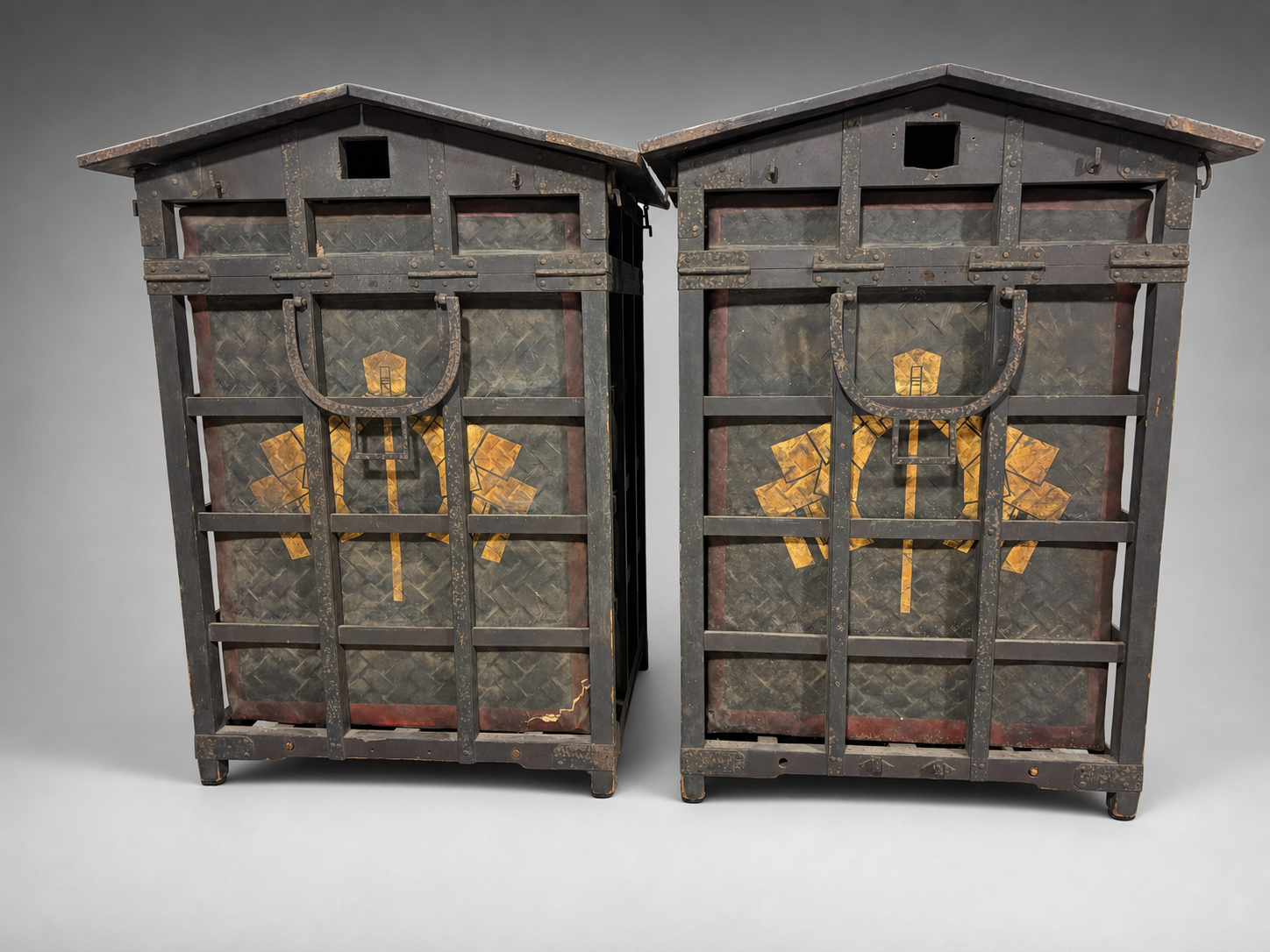
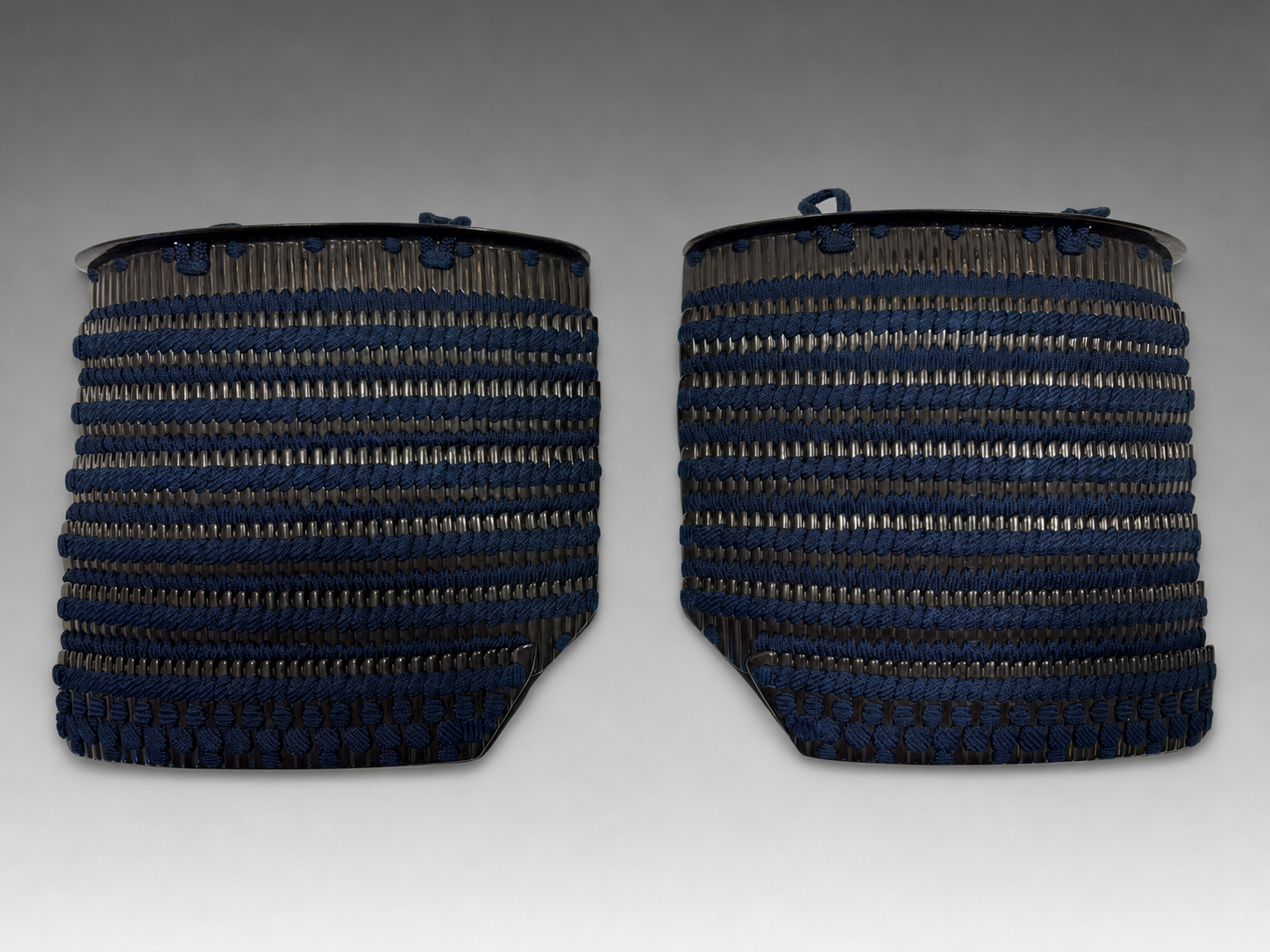
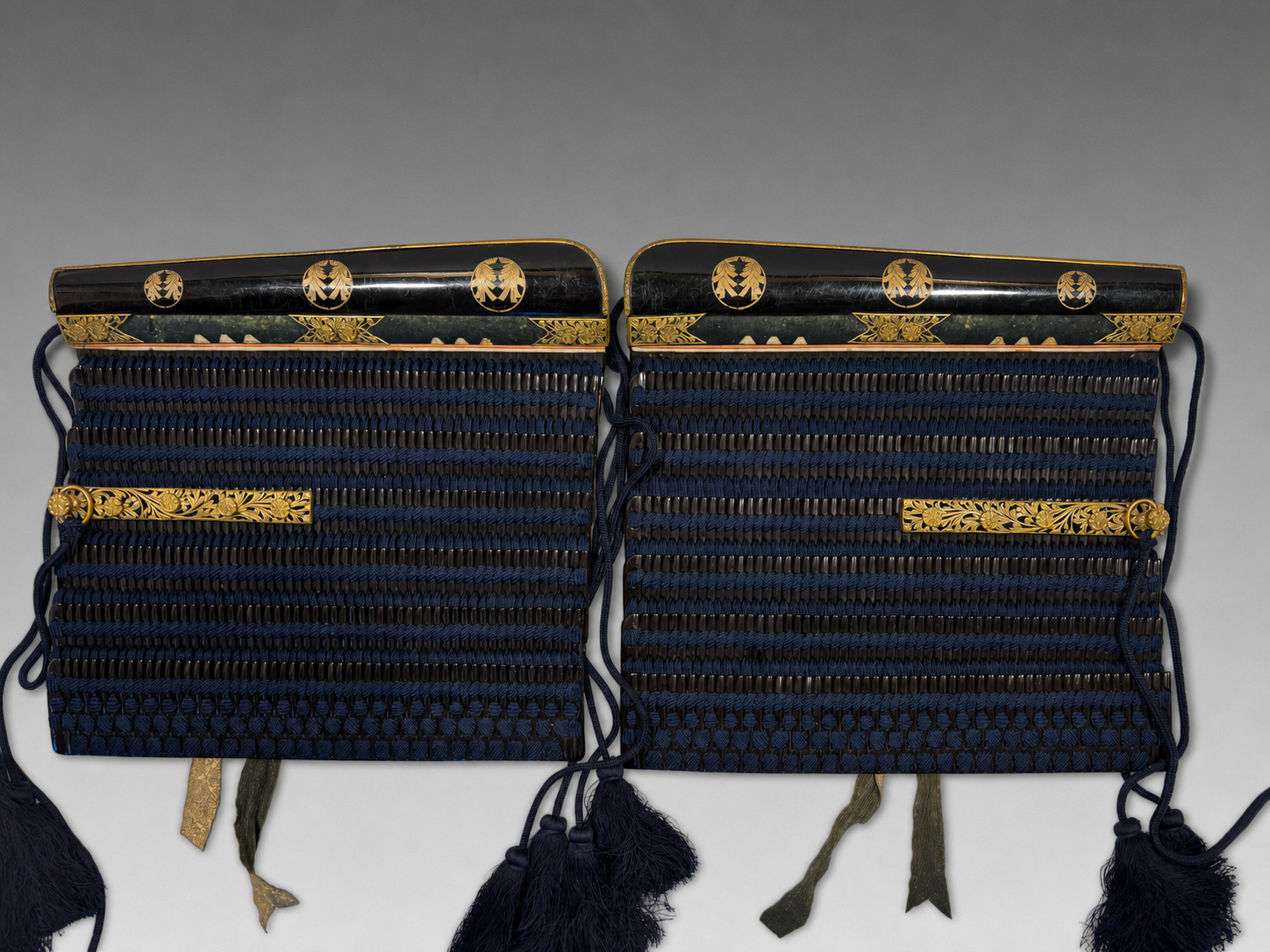
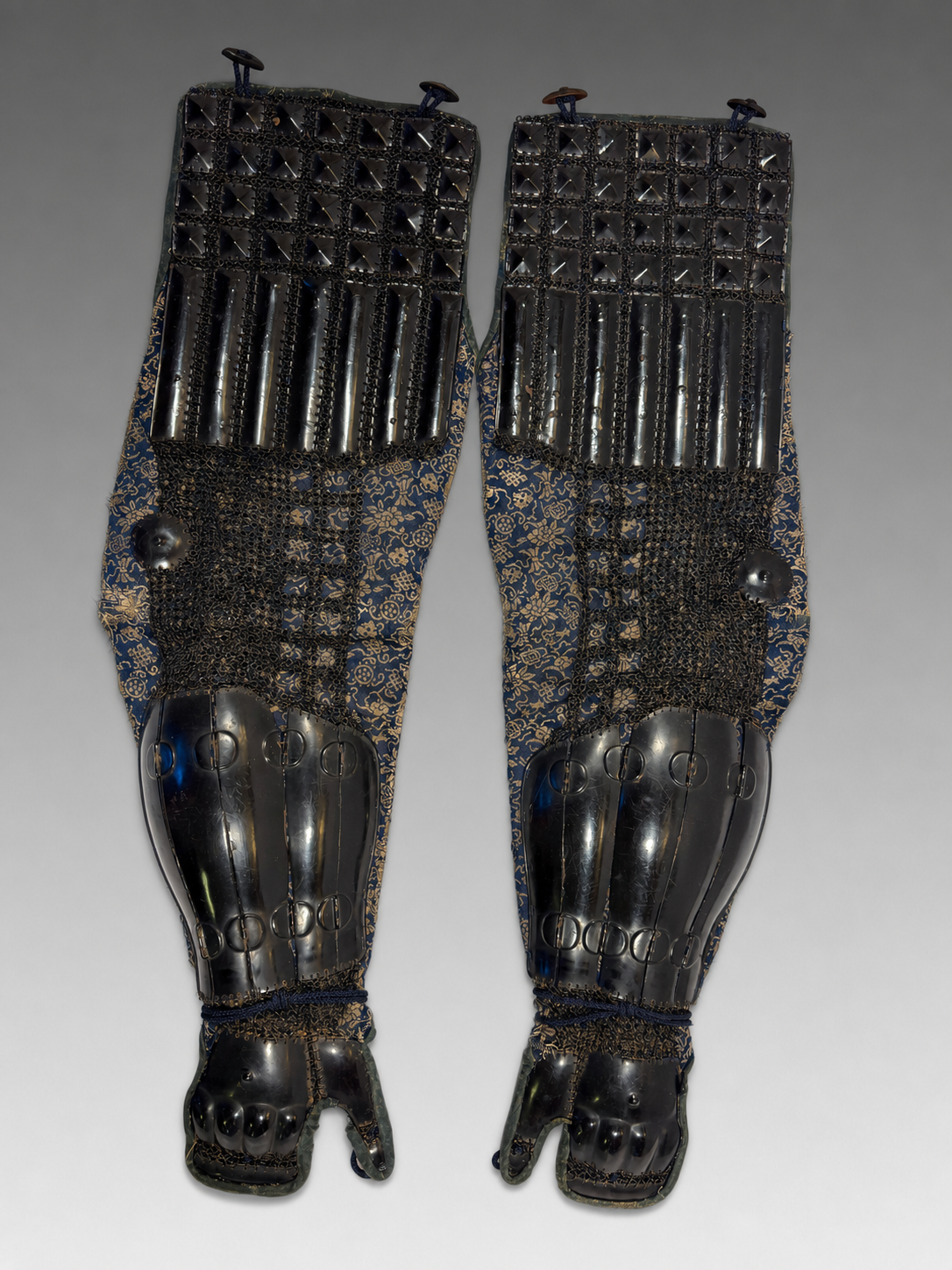
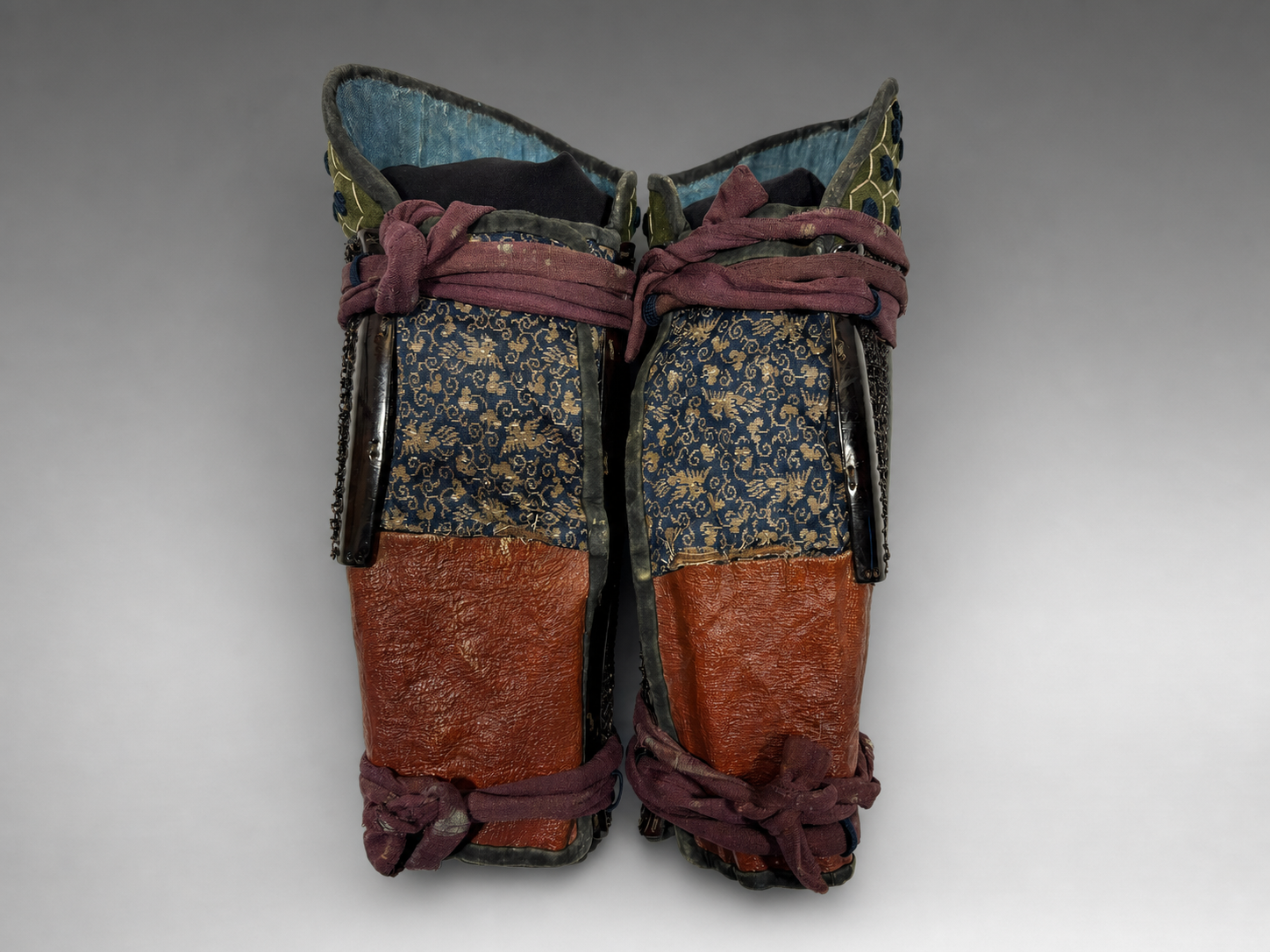
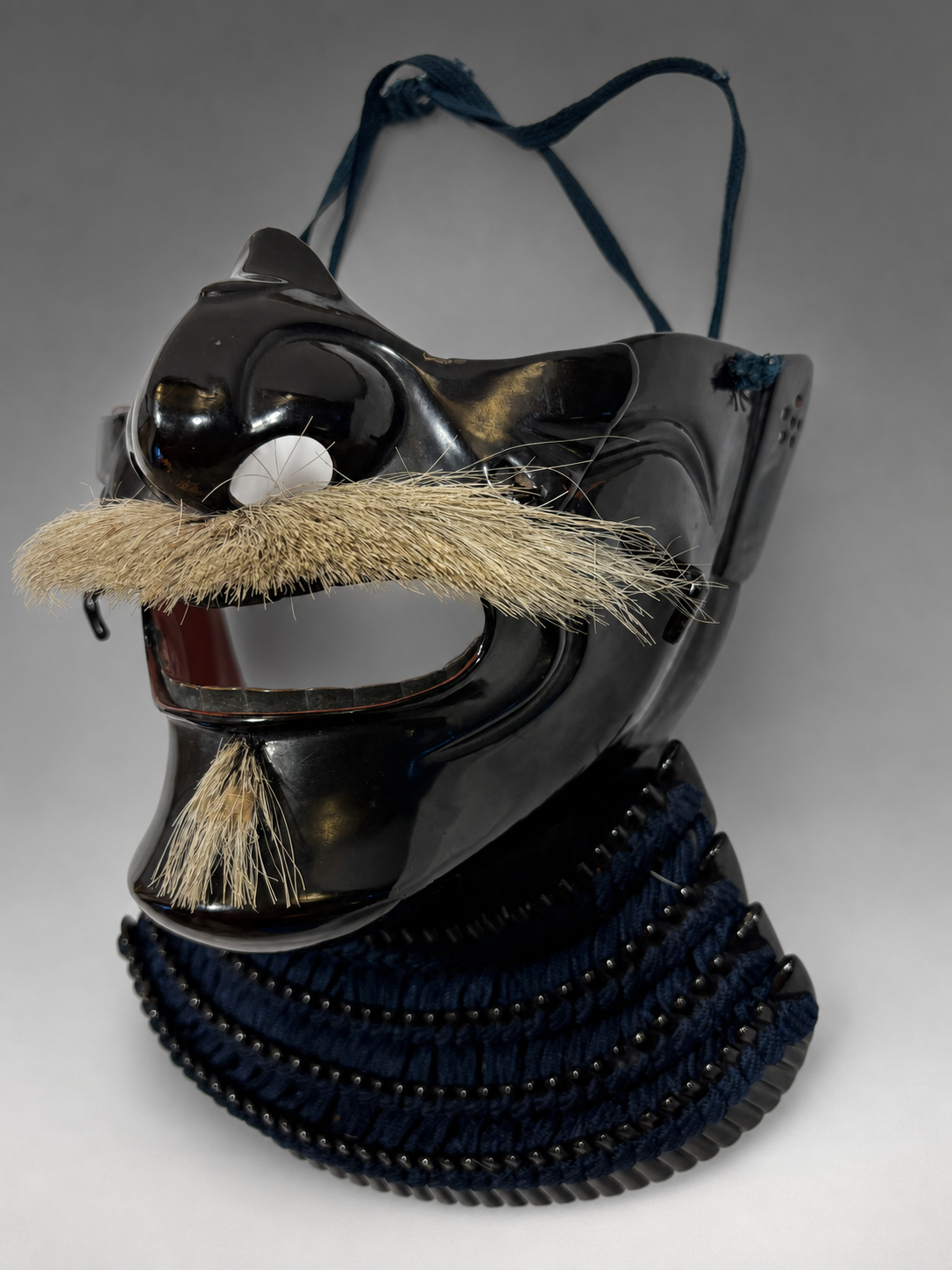
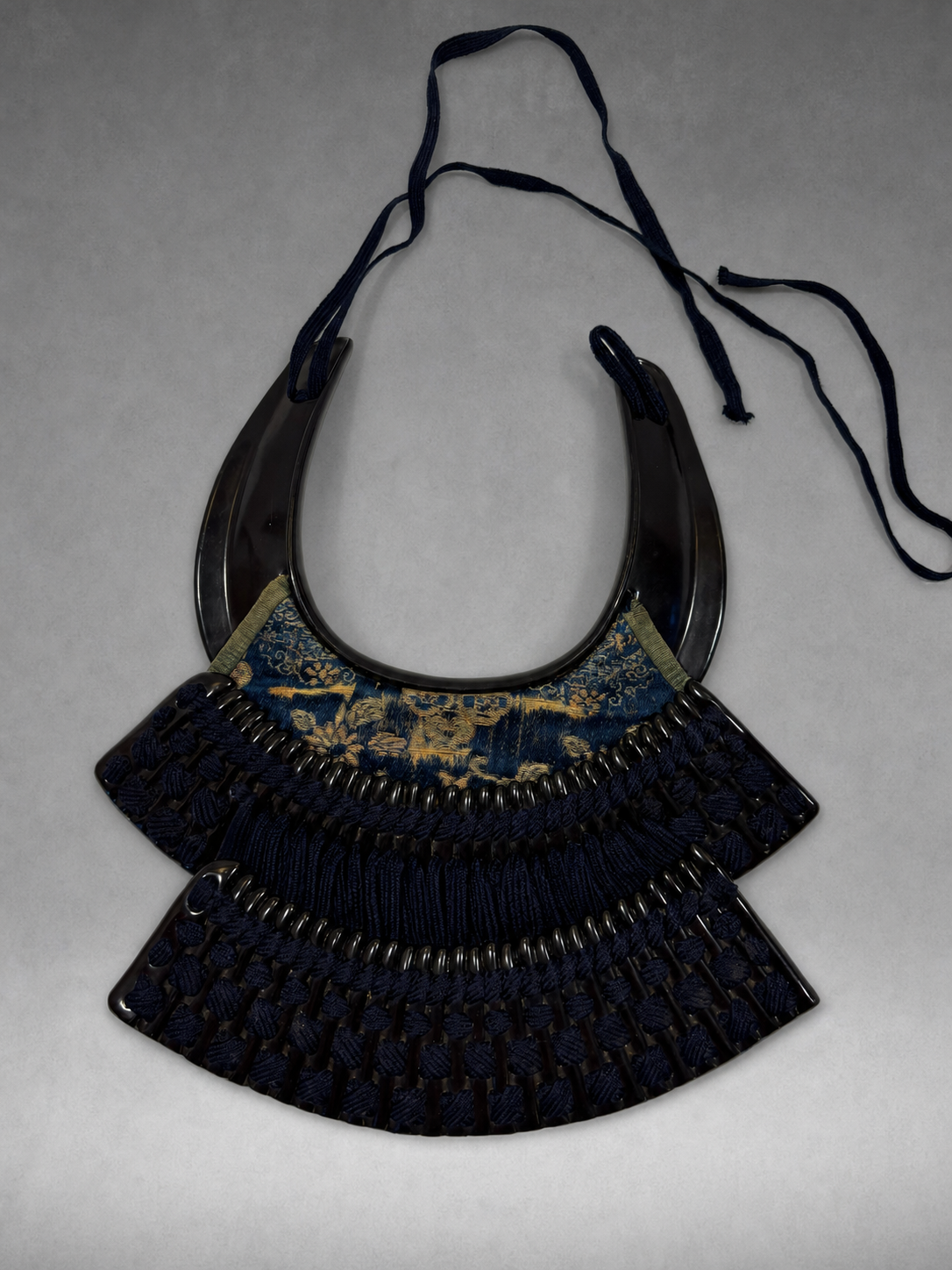
Kuro urushi nuri kon ito odoshi ni mai dō gusoku armour 切付小札紺糸威二枚胴具足, formerly in the possession of a daimyō of the Kamei clan 亀井, of the Honzumi Suzuki (Fujishiro Suzuki 藤白鈴木氏) lineage. Graded Jūyō Bunka Shiryō 重要文化資料 (“Important Cultural Material”). Mid-Edo period (1603–1868), 18th century.
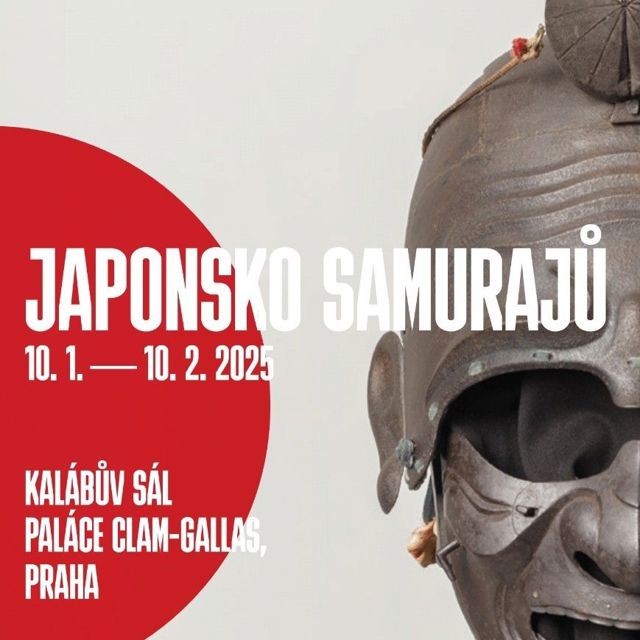
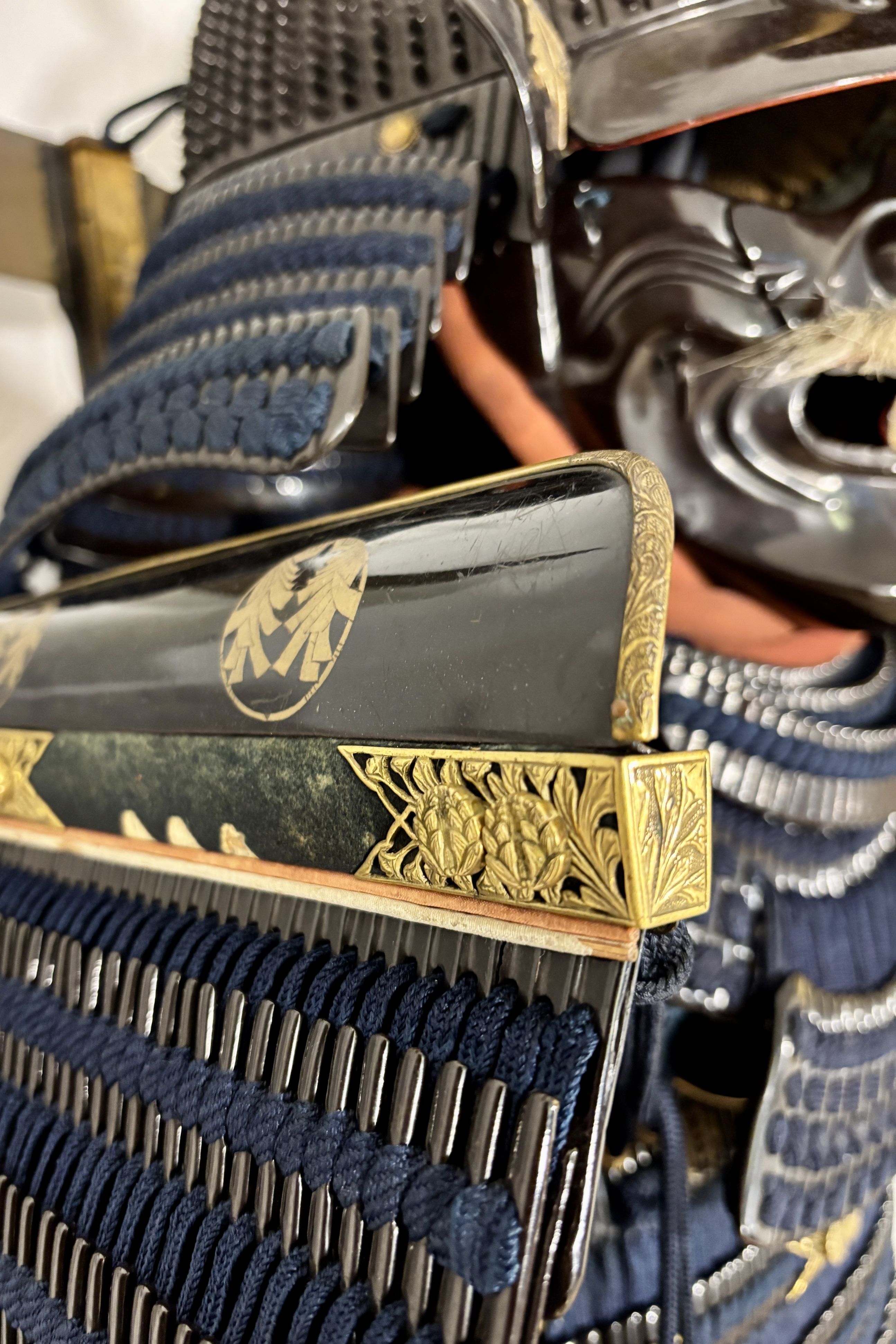
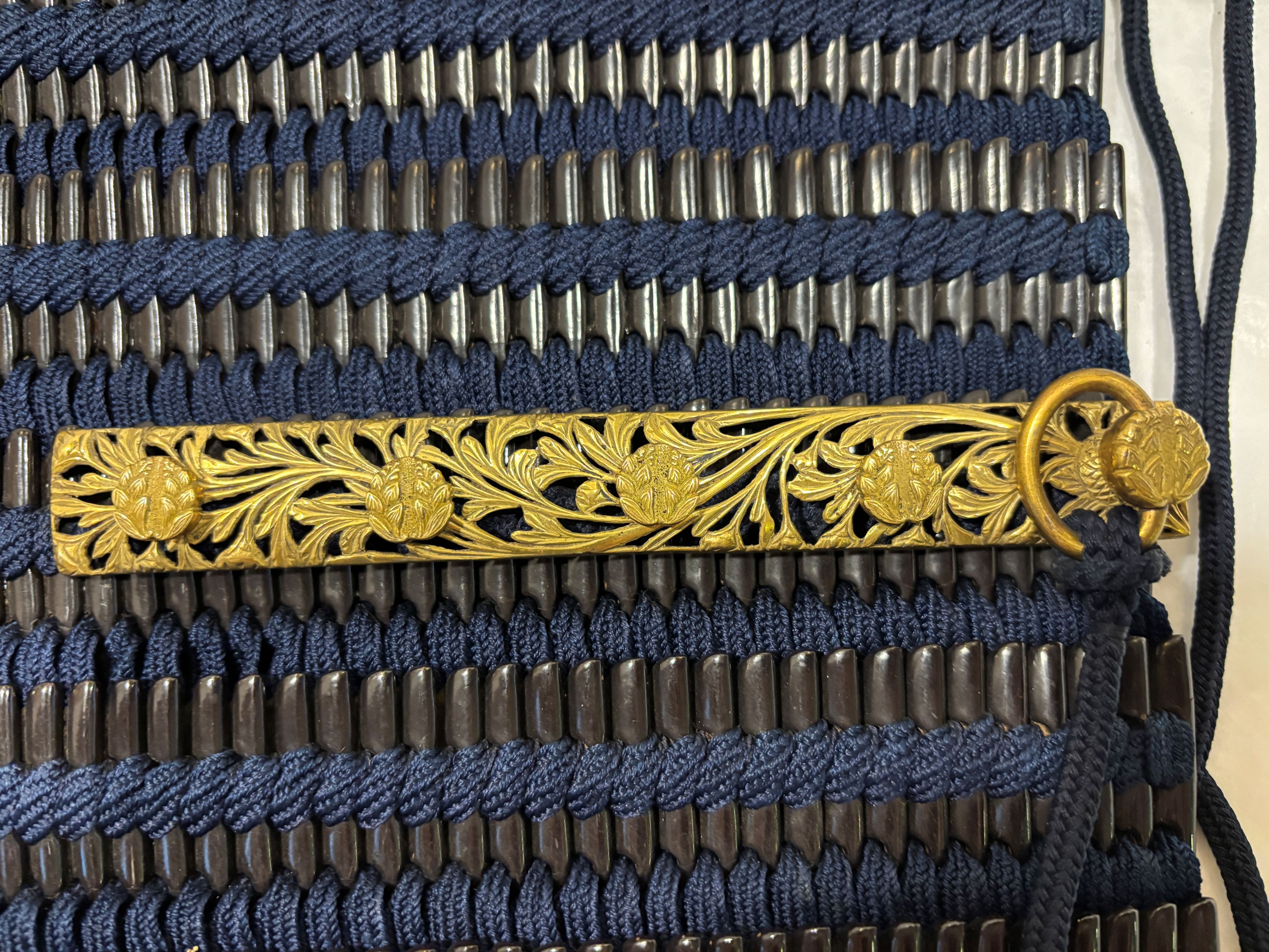
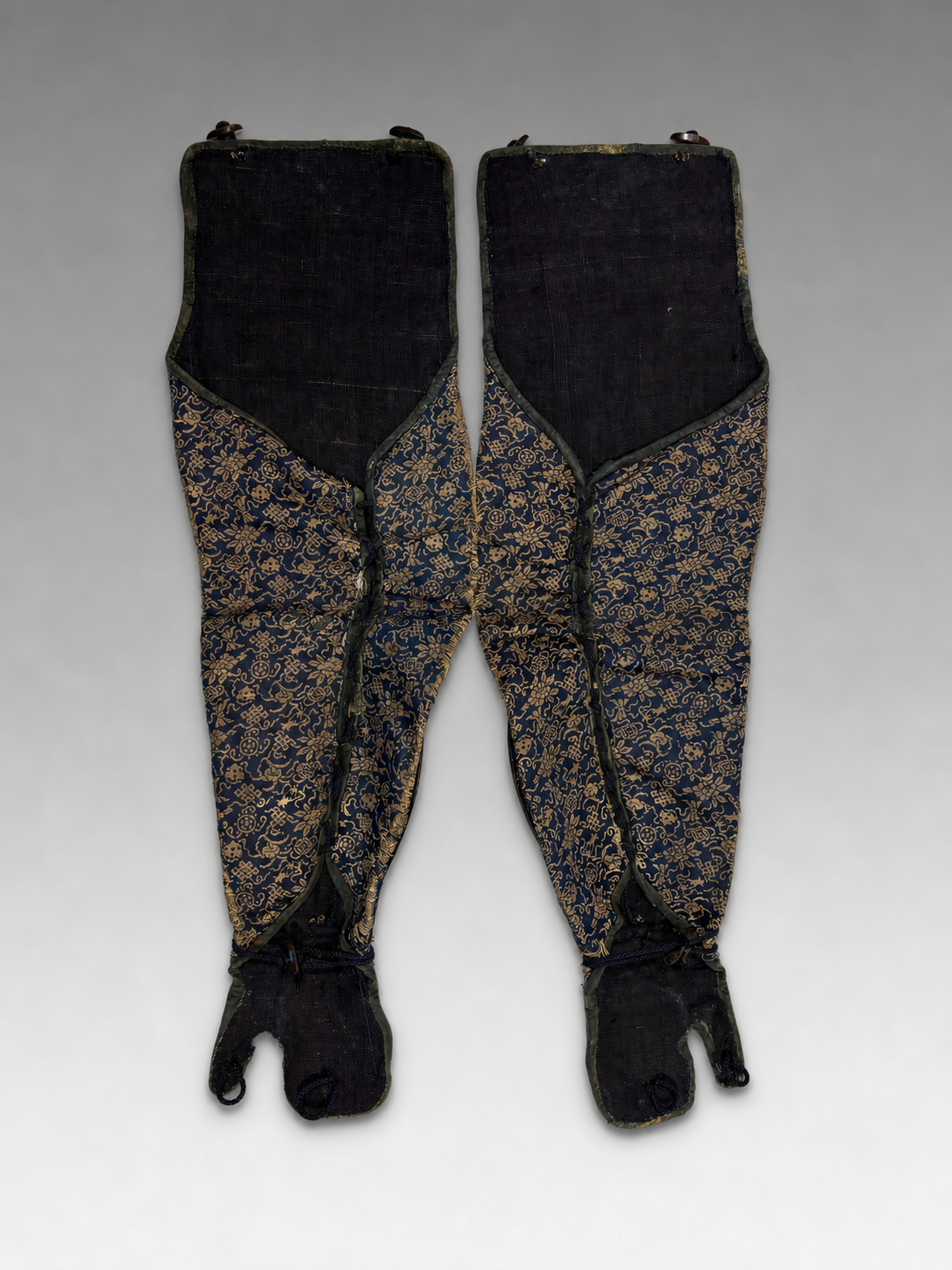
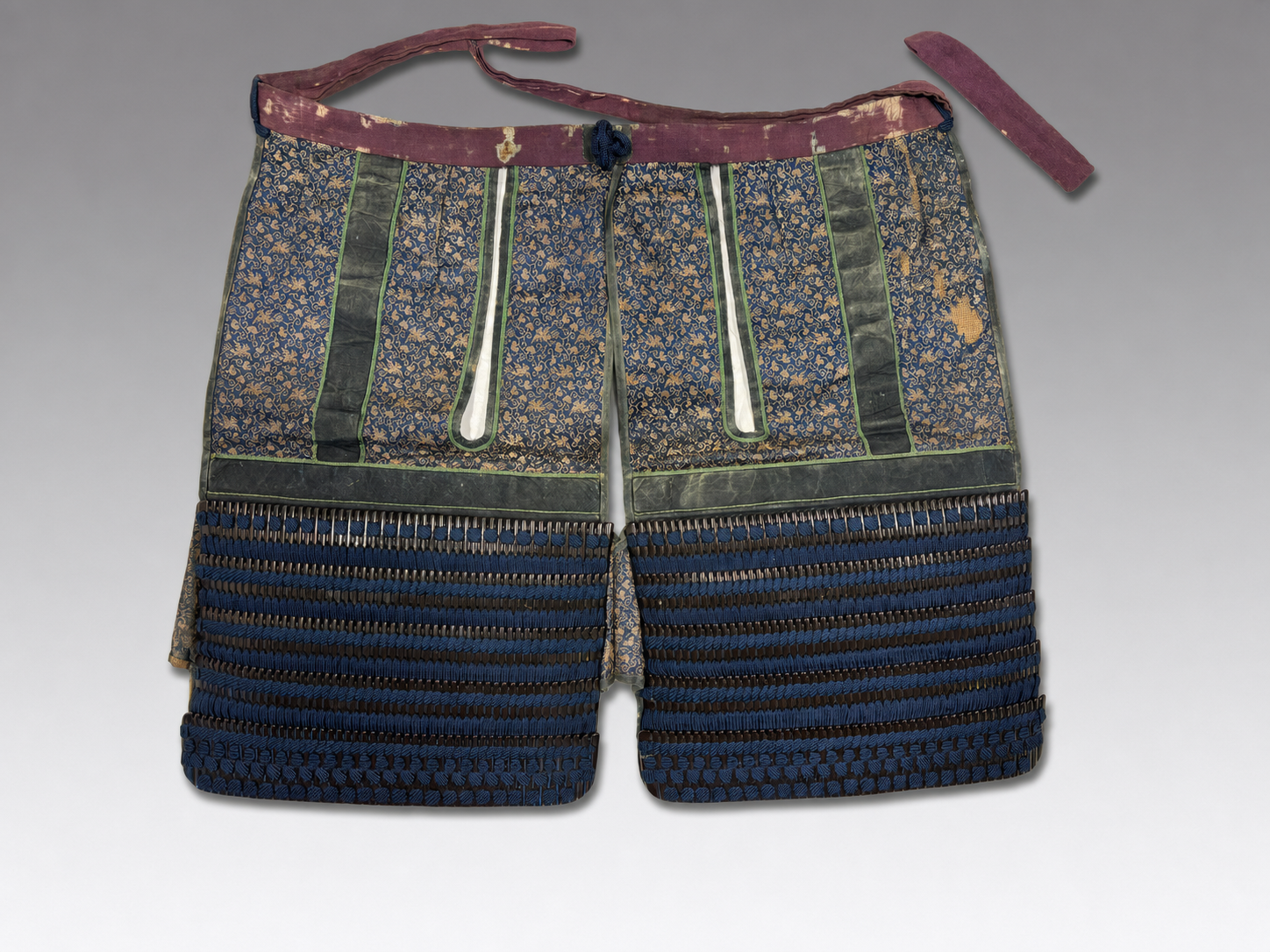
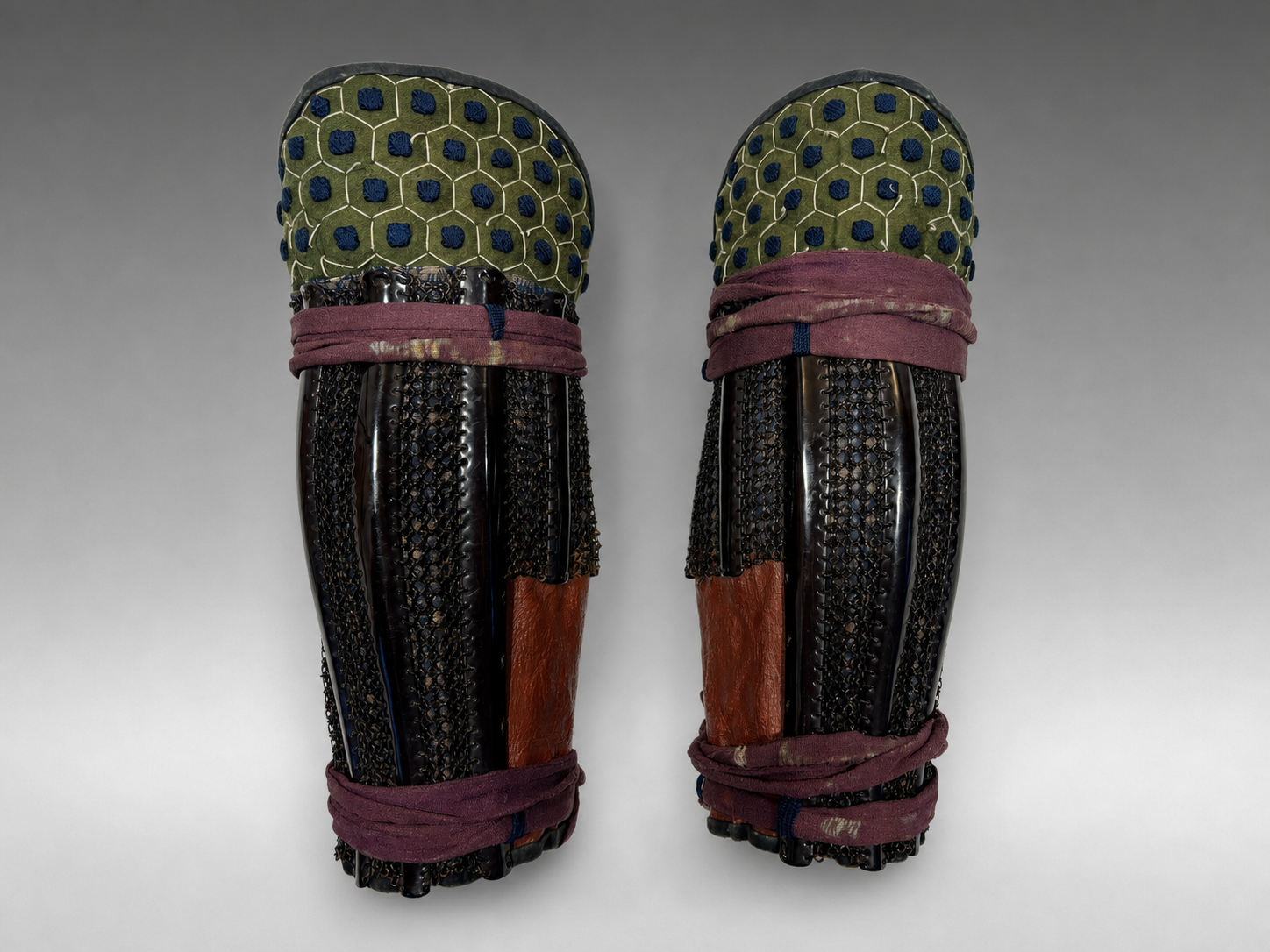
The armour features a magnificent seventy-two-plate koboshi kabuto of akoda-nari form, adorned with a double gilded sun-shaped maedate and kuwagata in the form of simple, flat horns. The kuwagata motif is repeated on a larger scale on the uketsutsu, the tube mounted at the back to hold a personal banner. The overall effect is striking and majestic. The fukigaeshi, like other parts of the armour, bear the Kamei clan’s family crest, or kamon. The menpō face mask, of the men-no-shita-bō type, is fashioned in the ressei-bō style, with an “angry expression”; its moustache and beard are made of badger hair. The tare throat defence suspended from the mask is supplemented by a separate, archaic neck guard known as a nodowa. The large ō-sode shoulder guards evoke the wearer’s high rank through their size and archaic form. More practical, modern types of armour used smaller tōsei-sode shoulder guards, but daimyō and samurai commanders sometimes favoured such historicising forms to emphasise their family’s martial tradition. A second pair of these smaller tōsei-sode shoulder guards, less ostentatious but more practical for actual combat, accompanies the armour and could be fitted as required. The fluted ō-sode have sumptuous gilt-metal fukurin edging, while the enlarged uppermost lame of each bears three family crests executed in the hira-makie lacquer technique. The tsutsu-gote arm defences are sewn onto a backing of blue brocade with a gold pattern of Chinese grasses and flowers. The same fabric lines the nodowa, the suneate shin guards and the haidate thigh defence. The dō cuirass is of two-piece construction (nimai-dō) and is made in the kiritsuke-kozane technique. Armour of this kind could take a year to make and contain more than a kilometre of odoshi-ito lacing. Some of the fukurin fittings bear engraved heraldic decoration depicting paired, opposing myōga ginger motifs. This emblem was used, for example, by the Nabeshima clan, which ruled Hizen Province. The kusazuri skirt comprises seven sections, each consisting of five lames. The haidate thigh defence matches the construction of the rest of the armour, and the ensemble is completed by shino-suneate shin guards. The armour is accompanied by two original yoroi-bitsu storage and transport chests bearing the corresponding family crest in the form of sacred pendants. Armour usually has only one such chest; the use of two is rare and is often associated with particularly precious suits and armour belonging to daimyō.
Historical note
The Kamei clan, originally from Kii Province, initially served the Amako clan and, following its downfall, the Oda and Toyotomi clans. During the Edo period, from 1617 onwards, the family ruled as daimyō of the mountainous, wooded Tsuwano domain in Iwami Province, in what is now Shimane Prefecture. The family was linked to the ancient Honzumi (Fujishiro) Suzuki 鈴木 lineage of Shinto priests and nobles, whose roots extended back to the Nara period (710–794). It was also related to the imperial family..
Appraisal
On 20 July 2026, the prestigious Nihon Katchū Bugu Kenkyū Hozonkai awarded this armour Jūyō Bunka Shiryō 重要文化資料, the highest of the five grades conferred by the society.
The price does not include shipping costs.
We are not just merchants. We are also guardians of cultural heritage.
Paid parking in the BCS building. Free parking available by arrangement. The history of Samurai Art began back in 1995. At its inception was an unwavering passion for the fascinating aesthetics and artisanal perfection of ancient Japan. This enthusiasm remains with us and motivates us to strive for the highest professional standards in our presentation of the material culture of the ancient samurai. Every sword or piece of armor in our collection is a unique, exceptional item with its own history. We collaborate with leading Japanese dealers and experts from prestigious Japanese organizations such as NBTHK and NTHK. We guarantee the authenticity and declared quality of all our gallery exhibits.
For serious buyers, we offer private viewings at our showroom in Prague.
By appointment only.
Nádražní 896/30, Prague 5
Schedule a meetingStories, Discoveries, and the Life of the Gallery